Sep 18, 2023 | Various |
If you regularly tinker with your car, you are bound to experience a messy workshop or garage. Tools, components and other parts are flying in all directions and it is difficult to keep everything together. Fortunately, there are... stacking bins who can solve these problems.
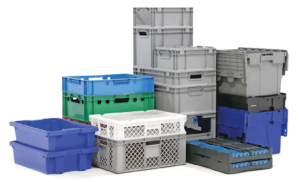 Stacking bins are sturdy bins that can be easily stacked on top of each other. They are available in different sizes and materials, so you can always find a bin that fits your needs perfectly.
Why use a stacking bin?
It is obvious but the main benefits are as follows:
- Resolved: Stacking bins help you keep your car neat and tidy. Everything has its own place, making it quick and easy to find the right tool or part. After all, it works a lot nicer when you know where everything is.
- Saving space: Stacking bins are a smart way to save space in workshop. By stacking the bins, you can fit more stuff into a smaller space. You can choose to place the bins in a rack or use special racks in which you can stack the stacking bins.
- Protection: Stacking bins provide protection for your tools and parts. They are made of sturdy materials that can take a beating. Most bins are fully enclosed but you can also choose perforated bins or bins with drainage holes.
- Easy to transport: Are you often on the road or taking, your tools to another location? Then the bins are ideal to take with you. By taking the bins with handles, you easily lift the bins from the garage to the boot.
Which stacking bin is right for you?
There are many different stacking bins on the market. To find the right bin for you, consider the following factors:
- First, the dimensions; the stacking bin should fit the stuff you want to store in it. Make sure the bin is big enough for all your tools and parts. Special high-volume bins are available for large volumes.
- Extra features; some stacking bins have extra features, such as a lid, viewing window or handle. A lid is useful to keep your things dry and dust-free. A handle makes it easier to move the bin.
- Foldable? If you don't always use the bins or want to transport them empty regularly, it's best to get a folding crate.
- Drainage holes? If there is a chance of liquids getting into the bin, it is best to choose a bin with drainage holes. Also, in case you have sprinkler systems installed in the room, it may be smart to choose these bins.
- Storing extra heavy items? Then choose the bins with a reinforced bottom.
- Besides plastic bins, there are also metal stacking bins; this can be useful if you have a large workshop and want to lift the bins with a forklift.
Ordering stacking bins?
Through Kruizinga's website, you will find a wide range of stacking bins. The bins are made of high-quality materials and are available in various sizes and colours. Besides new bins, they also have used, 2nd hand bins on offer.
Apart from the bins, you can also order handy stacking racks in which you can stack bins, trolleys for transport and racking configurations. So you can take care of your entire workshop at once. Save space, protect your stuff and keep your garage tidy. Want to read more about organising your garage? Then also read this item with more tips. And if you can't get enough of tidying up, read here more tips. Good luck!
Sep 15, 2023 | Maintenance and polishing |
Naturally, you want your lease car to be in top condition. Then it is very important to maintain your car properly. This way, you will, for example, counteract wear and tear and ultimately you will spend as little as possible on maintenance costs for your car. In this blog post you will read various maintenance tips for your lease car.
Lease contract
The cost of maintenance can vary from one lease contract to another. Often, maintenance costs are included in the lease contract. This means that these costs can then be paid by the leasing company. Incidentally, this does not apply to every lease contract: at financial lease you will have to pay for maintenance costs, among other things. So read up on the type of lease you are interested in. You can find out more by searching on 'business car leasing'.
Maintenance tips
Besides regular maintenance, you can also do several things yourself to keep your lease car in good condition.
Tip 1: Check tyre pressure
For example, you can regularly check your tyre pressure. Having the right tyre pressure ensures that your tyres wear out less quickly. And with the right pressure, you drive a lot safer and more economically: also not unimportant.
Tip 2: Check oil and fluids
Besides checking tyre pressure, it is also important to check the oil and all fluids. Top these up when necessary. If you check these properly and top them up when needed, you can extend the life of your car considerably. This way, you will avoid mechanical problems.
Tip 3: A clean car
Keeping your car clean is also an essential maintenance tip. Your car will then look nice, which of course gives it a well-groomed look which is important for a car of your business, for example. Cleaning the exterior of your car is also important. This also protects the paintwork. It is also good to regularly keep the interior nice and clean. This will prevent foul odours from lingering in your car. This is even more important nowadays. This is because of the various sensors and cameras a car is equipped with. A dirty camera will not allow you to see properly and dirty sensors cannot pick up as good signals.
Tip 4: Drive carefully
This goes without saying, but it is an important tip. Drive carefully and therefore avoid aggressive driving. Like braking too hard, accelerating fast and making sharp turns. This can cause certain parts of the car to wear out even faster.
Tip 5: Notice sounds
Pay close attention to your car. For example, if you hear crazy noises, this could be a sign that something is wrong. Think of squeaking or creaking noises. When you hear this, it is best to have it looked at immediately.
Sep 8, 2023 | Financial |
A business car is a vehicle that can affect the efficiency and appearance of your business. Whether you are just starting out or already quite a ways down the road, a business car can be a good purchase. When looking for a new business car, it is good to consider some things. In this blog, we will give you a hand in choosing your new business car.
Business needs
Before making your choice, it is very important to determine your business needs. What will you use the car for? Will you visit customers a lot, will you mostly transport goods or will you use the car mostly privately as well? How many passengers need to fit in the car and what space do you need? Understanding these factors will ensure you have a clear outline of the kind of car you are looking for.
Consider all options
Besides being able to buy a new car, you have several options. At companies such as Dutchlease you can choose to lease a car. This can be an interesting option. After all, you can choose from a wide range of cars. Don't want to pay too much? A occasion lease business from Dutchlease is also a good option. Here you choose from a range of used cars. This way, you do get to buy a car for your business without incurring too many costs. You can also choose to buy a used car. Do look carefully at the conditions before you buy it.
Budget and costs
Before making a bigger purchase for your business, it is important to look at the financial aspect of your business. Calculate your budget and take into account the purchase and additional costs. Look carefully at what you are looking for and what is within your budget. Also look carefully at maintenance costs. With some cars, parts are scarce, which can make the price skyrocket. If you opt for a business lease car, you do not have to take any repairs or insurance into account.
Sustainability
Sustainability is becoming increasingly important, including in traffic. Therefore, consider choosing a car with low CO2 emissions or opt for a hybrid or fully electric car. Not only will you contribute to a better environment, but you can also benefit from tax advantages and lower costs in the long run. These things also ensure a presentable appearance. This is very important when working with customers. Also, don't forget to take a test drive before buying the car. This way, you can be sure that you have chosen the right car that suits your needs. What will your new business car look like?
Sep 1, 2023 | Insurance |
Do you own a vintage car and want to insure it? And is this different from insurance for a new car?
Indeed, vintage car insurance differs from insurance for a new car in several ways because of the specific characteristics of vintage cars. First, let us look at what a vintage car is:
What is an oldtimer?
What is a vintage car? A vintage car is generally a vehicle that meets certain criteria to be considered an "oldtimer". These criteria may vary from country to country and insurer to insurer, but in the Netherlands the following applies:
An oldtimer is a vehicle that has reached a certain age, until 2014 this was so if a car was 25 years old or older. However, this has been changed, you can now only speak of an oldtimer when the car is older than 40 years.
This is the date of 1st admission on the registration certificate.
Vintage cars are often cars with limited use that are brought out for special events, exhibitions or on a nice summer day for a nice drive. Cars for the real enthusiast, in other words. They are often gems in excellent condition, lovingly maintained, restored and kept in original condition. Of course, there are exceptions to this 😉
Insurance for vintage cars
Now, regarding insurance for vintage cars:
Oldtimer Insurance vs. Insurance for a New Car:
- Possible lower premium: One of the potential advantages of insuring a vintage car is that premiums are usually lower than those for regular car insurance. This is because vintage cars are often used less and are usually well maintained, which reduces the risk of damage.
- Agreed value: Unlike most car insurance policies, where the value of the car is determined based on its current market value, vintage car insurance often allows you to agree on an agreed value. This means that you and the insurer agree how much the car is worth in case of a total loss, and you get paid that amount in case of a claim.
- Restrictions on use: Vintage car insurance policies may impose restrictions on the use of the car, such as a maximum mileage per year and requiring a second vehicle for daily use.
- Required membership: Some insurers may require you to be a member of a recognised vintage car club to qualify for vintage car insurance.
- Valuation report: When taking out vintage car insurance, you may have to provide a valuation report to establish the value of the car.
Where to buy vintage car insurance?
It is important to note that the exact terms and coverage of vintage car insurance policies can vary, so it is wise to talk to several insurers and compare quotes before making a decision. Also, the definition of a vintage car and the requirements for vintage car insurance can vary by region, so make sure you understand the local laws and regulations.
In any case, what comes highly recommended is to look at Univé's website. They have a good oldtimer insurance at a competitive premium. Univé has three variants of classic car insurance: WA, WA+ and All-risk. You can also choose various additional cover such as legal aid and damage for passengers/occupants.
In addition to car insurance, Univé also various other insurances.
Advantages of vintage car driving?
Driving a vintage car can provide certain (tax) benefits in some cases, but these benefits can vary greatly depending on location and specific legislation. Here are some potential benefits that can be associated with owning a vintage car:
- Vintage cars are also exempt from road tax, this only applies if the car is in your private name. This exemption does not apply to companies.
- If you want to import an oldtimer, you do not have to pay BPM. However, you will have to go through the BPM declaration procedure to get the vehicle registered in the Netherlands.
- Possible lower insurance premiums: As mentioned earlier, vintage cars sometimes have lower insurance premiums because they are considered hobby vehicles and are usually used less. This can result in savings on insurance costs.
- Reduced depreciation: In some cases, the depreciation (drop in value) of a vintage car can be slower than that of a regular car. This means you have less capital loss, which can be beneficial if you want to sell the car.
- Last but not least, everyone will look at you admiringly as you drive by in your beautiful car. Not wrong!
However, it is important to note that these benefits are not universal and can vary greatly depending on your location and the specific laws and regulations that apply there. Moreover, some benefits may only apply to vintage cars that meet certain criteria, such as a minimum age or rarity.
Aug 10, 2023 | EV |
A plug-in hybrid car (PHEV) is a car that has both a combustion engine and an electric motor. Some people do say, the best of 2 worlds! The electric motor can be charged through a plug, giving the car an electric range. If the battery is dead, the car can still run on the combustion engine and you, don't have to worry about the nearest charging station.
More and more plug-in hybrids are entering the market but is it a smart choice? In this article, the pros and cons of a PHEV.
What are the advantages of a plug-in hybrid?
The advantages of a PHEV are:
- Lower CO2 emissions than an internal combustion engine-only car
- Lower fuel costs than an internal combustion engine-only car
- Quieter driving than an internal combustion engine-only car
- More power than a car with only an electric motor
- Discount on road tax (although this will be slowly phased out)
The disadvantages of a PHEV are:
- The purchase price is higher than an internal combustion engine-only car
- The battery should be charged regularly
- Range on electricity is limited
- The battery makes the car heavier
In general, PHEVs are a good choice for people who want a car with low CO2 emissions and lower fuel costs. Plug-in hybrids are also a good choice for people who regularly make short journeys, as they allow you to drive fully electric and save considerably on fuel.
Do you still need to fill up with a plug in hybrid?
Suppose you only make short trips and can actually drive on the electric motor all the time, is it still necessary to refuel? Unfortunately, yes. It is not possible to drive only electric, occasionally it is necessary to drive on the fuel engine. In fact, you will find that a PHEV will automatically give notification that you need to drive on fuel. In some cases, it will even give this automatically. Why is that?
Shelf life of fuel in PHEV
The shelf life of fuel in the tank depends on a number of factors, including fuel quality, temperature and humidity. Generally, fuel in a closed tank lasts about 3 months. If the tank is not completely full, water can enter the tank, reducing the fuel's shelf life. Also, the fuel may oxidise, making it burn less well.
With a plug-in hybrid car, you need to fill up less often than with an internal combustion engine-only car. This is because you can charge the car with electricity. The exact frequency of refuelling depends on how you use the car, its electric range and the availability of charging points. If you drive the car mainly electric, you might only need to refuel once a month. If you often drive the car long distances, you may need to refuel more often.
Either way, it is necessary to run on fuel regularly so that the tank runs out and you have to fill up with new fuel. This is important for preserving the engine, starter battery and other components in the car. This way, you ensure that the engine keeps running properly.
What are the financial benefits of a PHEV?
At the time of writing (2023), there is really only 1 financial benefit for plug-in hybrids (besides lower fuel consumption); road tax rebates.
Road tax is a tax you have to pay if you own a car. PHEVs with CO2 emissions of less than 50 grams per kilometre get 50% rebates on this tax. This has been extended until 2024.
Previously, there was also discount on purchase tax (BPM), lower additional taxable income and subsidy on purchase costs but this has since been abolished. These benefits now only apply to fully electric vehicles.
Is a plug-in hybrid really environmentally friendly?
PHEVs are generally more environmentally friendly than combustion-only cars, but of course they have higher emissions than fully electric cars. The CO2 emissions of a PHEV depend on how the car is used. If the car is mainly driven electrically, CO2 emissions are low. If the car is often driven long distances on the combustion engine, CO2 emissions are higher.
Research shows that in practice, the CO2 emissions of PHEVs are often higher than promised by car manufacturers. In practice, this is mainly because the range of PHEVs is limited and many people drive long distances on fuel. Because a plug-in hybrid has a heavy battery on board, it is a heavy car which naturally requires a lot of fuel. The petrol (or diesel) engine then has to work hard to reach the desired level, leading to much higher emission values than a normal petrol or diesel car.
It is therefore not for nothing that the government is phasing out tax breaks for PHEVs. In practice, these cars are not at all as environmentally friendly as the manufacturers promise, so preferential financial treatment would be misplaced.
How can you reduce the CO2 emissions of a PHEV?
If you want to buy a PHEV, it is important to be aware of the car's CO2 emissions. You can reduce a PHEV's CO2 emissions by charging the car often and by driving electric for short distances.
Here are some tips to reduce your PHEV's CO2 emissions:
- Charge the car regularly.
- Drive electric for short distances.
- Avoid driving on the internal combustion engine when not needed.
- Choose a PHEV with low CO2 emissions.
What is the measurement method for emissions?
The European Commission has developed a measurement method for the emissions of plug-in hybrid cars (PHEVs). This method is called WLTP, which stands for Worldwide Harmonised Light Vehicles Test Procedure. WLTP is a harmonised test method for measuring the fuel consumption and CO2 emissions of light vehicles. The test method was developed by the International Organisation for Standardisation (ISO) and the International Council for Engine Purity (SAE International).
WLTP is a more realistic test method than its predecessor, NEDC (New European Driving Cycle). NEDC was based on a theoretical driving pattern that did not match real-world conditions. WLTP is based on a driving pattern composed of a number of different driving modes, including city driving, highway driving and country roads.
WLTP is a complex testing method that costs a lot of time and money. However, the test method is necessary to get a realistic picture of the fuel consumption and CO2 emissions of PHEVs.
The European Commission has made the WLTP test method mandatory for all new PHEVs launched on the market from 1 September 2018.
At the time of writing, the European Commission is also busy working on an even more realistic measurement method of the consumption and emissions of plug-in hybrid cars. This may yet have a big impact on, for example, road tax, sales prices and availability of (new) PHEV cars. We look forward to hearing about developments!
Popular PHEVs
There are many popular plug-in hybrid cars on the market. Some of the most popular models are:
- Volkswagen Golf GTE: The Golf GTE has an electric range of 59 kilometres.
- Kia Niro Plug-in Hybrid: The Niro Plug-in Hybrid has an electric range of 62 kilometres.
- Hyundai Ioniq Plug-in Hybrid: The Ioniq Plug-in Hybrid has an electric range of 66 kilometres.
- Ford Kuga Plug-in Hybrid: The Kuga Plug-in Hybrid has an electric range of 50 kilometres.
- Toyota RAV4 Plug-in Hybrid: The RAV4 Plug-in Hybrid has an electric range of 61 kilometres.
- Mercedes C300e plug-in hybrid
- BMW 330e

 EN
EN  NL
NL  DE
DE