Jul 26, 2023 | Electronics |
If you buy a Ford with integrated car radio, you may need to find the code that unlocks your radio when the car's battery is replaced. If the car radio is removed from the car and reinstalled in another car, the radio will also not work without the code. The code is linked to the radio and the car, so even if the radio is repaired or replaced, it will not work without the correct code.
The code is a security measure by Ford to protect your car radio from theft and ensure its exclusive use in your car. Don't worry, there are several ways to find the code for your car radio.
What is a Ford car radio?
A car radio is an electronic device installed in a motor vehicle that can receive and play radio signals and play various audio media. The Ford car radio is designed to fit into the dashboard of any Ford car model. The Ford car radio can offer various functions, such as CD, DVD or digital audio playback, Bluetooth connectivity for music streaming and hands-free calling, radio and sometimes even advanced features such as integrated GPS navigation.
Ford car radio: how do I find the code?
Looking for the code in the car papers: The first place to look for the car radio code is in your Ford's car papers. It is possible that the car radio code is written down somewhere. You may also find information on a separate card or in documents specific to the car radio.
- Finding your car radio code online: If you cannot find the car radio code in the car papers, you can find it out through online services. On sites such as cargroov.co.uk you can retrieve the code directly online at an affordable price. To find out the code, you will be asked for the serial number of your car radio. You can find this number by removing the car radio from the slot or by using a combination of keys. Consult the website for more information. This method of finding out car radio codes is the most popular because of its price and simplicity.
- Contact a Ford dealer: Another option is to contact a Ford dealer. Find the contact details of a Ford dealer near you. You can search online or use Ford's mobile app to find the nearest authorised dealers. The Ford dealer representative will likely ask you for information to verify your ownership of the vehicle. Be prepared to provide your registration number, name, address and other information to confirm your identity and connection to the vehicle. This service is rarely free, but you should be aware that you usually have to pay for it as the rate varies from dealer to dealer and can be quite high.
How do I enter the code in the car radio?
 Depending on the Ford model, there are different ways to enter the code into your car radio. On some models, all you have to do is type in the code and press the "OK" button. On older models, you have to use the keys 1 to 4. These keys do not correspond to a specific digit, but to the position of the digit in your code. So for the first digit of the code, you have to press the "1" button a certain number of times. If the digit is 4, you have to press the "1" button four times. If the second digit of the code is 9, you have to press the "2" button nine times, and so on.
Tips so you don't lose the code again!
Here are some tips to avoid losing your radio's code:
- Keep the code in a safe place, such as in your car papers or in a safe.
- Take a picture of the code with your phone.
- Write the code on a piece of paper and keep it in your car.
- If you lose the code, you can usually get it from the dealer or the manufacturer of the radio.
Jul 20, 2023 | Financial |
Private lease is a form of car rental where you rent a car for a predetermined period for a fixed monthly fee. With private lease, all costs for the car are included, such as road tax, motor vehicle tax, maintenance, repairs and insurance. So you don't have to save for a down payment or pay for unexpected costs yourself.
Advantages of private leasing
 There are many advantages to private leasing. You always have a new car, you don't have to worry about maintenance and repairs, and you know exactly where you stand. Private lease is also a good option for people who don't drive many miles, because you only pay for the kilometres you actually drive.
Are there any drawbacks?
However, there are also some drawbacks to private leasing. The monthly amount is often higher than the monthly cost of car insurance and maintenance contract. Moreover, you are tied to a certain duration, and if you want to terminate the lease in the interim, you often have to pay a penalty.
How is the monthly amount of private lease determined?
There are a number of factors that determine the monthly amount with private leasing. These factors are:
- The purchase price of the car: The purchase price of the car is the most important factor determining the amount of the monthly amount. The more expensive the car, the higher the monthly amount.
- The term of the lease: The term of the lease contract also affects the monthly amount. The longer the term, the lower the monthly amount.
- Mileage per year: The number of kilometres you drive per year also affects the monthly amount. The more kilometres you drive, the higher the monthly amount.
- Insurance premium: The insurance premium is another factor that determines the monthly amount. The insurance premium depends on the car, the driver's driving experience and where the driver lives.
- Road tax: Road tax is an annual tax you have to pay for using your car. The amount of road tax depends on the car and the province where you live.
- Maintenance and repair costs: Maintenance and repair costs are not included in the monthly amount, but may be a factor when calculating the monthly amount. The amount of maintenance and repair costs depends on the car and the driver's driving habits.
- Fuel costs: Fuel costs are not included in the monthly amount, but may be a factor when calculating the monthly amount. The fuel cost depends on the car, the driver's driving style and fuel prices.
- The down payment: A down payment is not mandatory with private leasing, but it can be a factor in calculating the monthly amount. A down payment reduces the monthly amount, but you have to repay the down payment at the end of the lease contract.
It is important to carefully consider all the factors that determine the amount of the monthly payment before signing a private lease.
What is the difference with financial leasing?
Private lease is different from financial lease. With private lease, you rent the car, while with financial lease, you buy the car. With financial lease, you pay a monthly amount in principal and interest. At the end of the term, you can take over the car, but you can also return it to the leasing company.
Conclusion private lease
In general, private lease is a good option for people who do not want to buy a car, but want to enjoy the benefits of a new car. It is important to carefully compare the pros and cons of private lease with the alternatives, such as buying a car or renting a car.
Are you convinced and want to move forward with private lease then there are several parties who can advise you (online). Here are some tips for choosing a private lease:
- Compare different leasing companies and rates.
- Choose a car that suits your budget and driving habits.
- Make sure the contract is clear and transparent.
- Read the small print carefully.
- Test drive the car before signing a contract.
Jul 20, 2023 | EV |
A plug-in hybrid (PHEV) car is a car equipped with both a combustion engine and an electric motor. The electric motor is powered by a battery that you charge by connecting the car to the mains, in most cases this will be a charging station. So a PHEV is a car that allows you to drive both (fully) electric and fuel.
What hybrid varieties are there?
There are three different types of hybrid cars:
- Mild hybrid: a mild hybrid car is a car that combines a combustion engine with a small electric motor. The electric motor is powered by a small battery charged by the combustion engine and by braking energy recuperation. Mild hybrid cars do not have a plug, so they cannot be charged from the mains.
- Full hybrid: a full hybrid car is a car that combines a combustion engine with an electric motor. The electric motor can drive the vehicle independently, but the combustion engine is also used to charge the battery. Full hybrid cars have a plug that you have to use to charge them.
- Plug-in hybrid: a plug-in hybrid car has a battery large enough to drive the vehicle a certain distance on electric power. This range is often limited and varies from brand to brand. However, you can charge the battery using a cable and a charging pole. You see this model more and more often on Dutch roads.
Mitsubishi hybrid models
The Mitsubishi Eclipse Cross PHEV and the Mitsubishi ASX PHEV are both plug-in hybrid cars. We briefly discuss both models below:
Eclipse Cross PHEV
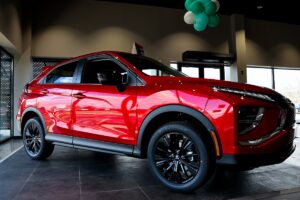 With Super-All Wheel Control (4WD), this car offers excellent grip and control on any type of terrain. The combined power of 138 kW (188 hp) and maximum towing weight of 1,500 kg make this car perfect for daily use and adventurous trips. With fuel consumption of just 2.0 l/100 km (combined, WLTP) and an electric range of 45 km (WLTP), this car is also very efficient.
ASX
The new Mitsubishi ASX combines a spacious feel with advanced driving assistance systems, a high level of driving comfort and is available with different powertrains: petrol, Mild Hybrid (MHEV), Full Hybrid (HEV).
Power ranges from 91 to 159 hp, and with a maximum towing weight of 1,500 kg (1.3 DI-T 7DCT), this car is also suitable for towing heavy loads. With fuel consumption (combined, WLTP) ranging from 1.3l/100km to 5.9l/100km, this car is also very efficient.
Difference between hybrid and all-electric?
The main difference between a fully electric car and a hybrid car is that a hybrid car also has an internal combustion engine. This means that a hybrid car has a greater range than a fully electric car. However, a fully electric car can drive more economically than a hybrid car because there is no combustion engine wasting energy.
Hybrid cars are a good choice for people who want to save on fuel costs and reduce CO2 emissions. Plug-in hybrid cars are a good choice for people who often drive short distances and want to enjoy the benefits of an electric car.
Jul 14, 2023 | Financial |
Short lease is a form of car leasing distinguished by its flexibility. It allows companies to lease a car for a shorter period of time, without long-term contracts and obligations. Unlike traditional car lease contracts, the term of short lease usually varies between one and 12 months.
The advantages of short lease
One of the main advantages of short lease business is the flexibility it offers businesses. Unlike long-term leases, short lease allows companies to easily respond to changing needs or seasonal demand. This makes it ideal for start-ups or companies that have temporary projects requiring extra cars, for example.
 In addition, short lease is also great for companies that need a car quickly. With traditional car leases, it can sometimes take weeks before a car is available. With short lease, on the other hand, a company can have a car within days.
Cost savings
short lease can also bring significant cost savings for companies. Since there are no long-term contracts, companies can easily adjust their fleets according to their current needs. This means there are no unused cars costing money. Moreover, monthly rates for shortlease are often competitive and usually already include the cost of insurance, maintenance and roadside assistance.
No long-term commitments
Another advantage of short lease is that companies are not tied to long-term commitments. This means they are not at financial risk if their needs change or unexpected events occur. Companies can simply terminate the contract whenever they want, without high fines or other penalties. Partly because of this, flex lease an excellent choice!
Short lease or traditional lease?
While both short lease and traditional car leasing offer solutions for business mobility, there are some key differences between the two.
Duration: As mentioned earlier, the term of short lease usually varies between one and 12 months. Traditional car lease contracts, on the other hand, often have a term of two to five years. This makes short lease much more flexible and suitable for companies in need of short-term mobility solutions.
Cost: In traditional car leasing contracts, monthly rates are often based on a fixed amount per month throughout the term of the contract. With short lease, the rates per month can vary depending on the term chosen. This means companies only pay for the period in which they actually use the car, which can be cost-saving.
Maintenance and insurance: With traditional car leases, companies are often responsible for arranging and paying for maintenance and insurance themselves. With short lease, on the other hand, these costs are usually already included in the monthly rate. This provides extra convenience and transparency for companies.
Conclusion
short lease is a flexible and cost-effective solution for business mobility. It allows companies to meet their mobility needs quickly and easily, without long-term commitments.
With the benefits of flexibility, cost savings and convenience over traditional car leases, short lease is an attractive choice for many businesses. Therefore, consider short leasing if you are looking for a flexible mobility solution that can boost your competitiveness.
Jul 13, 2023 | BMW |
Our beloved BMW 3 series is available in the following hybrid petrol models:
- BMW 320e Touring
- BMW 330e Touring
- BMW 320e Sedan
- BMW 330e Sedan
BMW really struck a chord with its buyers when it introduced the 330e plug-in hybrid. The company estimates that a quarter of all 3-series buyers choose this model - no wonder, since it often comes up in lists for best hybrid cars.
BMW 320e and 330e
First, the 3-series is as we have come to expect, very nice to drive and class-leading - despite the battery. On the other hand, the claimed range of 57-62 km is so useful for electric driving alone that it will cover many drivers' commutes. This need not be a disadvantage if you do a lot of short trips.
 And finally, there is the XtraBoost feature that temporarily boosts the combined petrol-electric power by 41 extra horsepower.
You also get all the features we love about the standard BMW 3-series - its supportive seats, excellent roadholding, smartly understated design and a selection of technology that is advanced but user-friendly.
Its main German rival is the Mercedes-Benz C 300e.
What about power BMW 330e?
The BMW 330e combines the same 2.0-litre four-cylinder turbocharged petrol engine found in the regular 320i with an electric motor, neatly integrated into the eight-speed Steptronic automatic gearbox.
The packaging is so good that the body is only 15 mm longer than the standard eight-speed automatic fitted elsewhere in the 3-series. Having the engine in this position is also good for efficiency, especially when it comes to regenerating braking energy.
The petrol engine produces 184 hp (the same as the 320i) and gets support from the electric motor, bringing output to 252 hp. Added to this is the impressive XtraBoost feature (temporarily 41 hp extra!).
How does XtraBoost work on the BMW 330e?
We were hoping for a button similar to Porsche's Sport Response. But in fact, it is just an additional part of the BMW Sport driving mode settings, and it is activated by selecting it and then firmly pressing the accelerator.
Since the jump to 293 hp is delivered entirely by an extra 41 hp jolt from the electric motor, the effect is quite impressive. So much so that BMW reckons it will give you twice as much 'power' from 20 km/h within a second as a similarly powerful fuel-engined car. The result? Acceleration from standstill to 100 km/h in no more than 5.9 seconds.
Exactly the kind of performance BMW buyers are probably looking for.
A joy on the road?
In short, absolutely. Wake it up by firmly pressing the right pedal, or leave it in Sport mode, and the 330e shoots forward and leaves everything behind it. Being a BMW, it also has the chassis composure to carry through that initial acceleration into corners without going off the road.
On paper, 0-100 km/h takes 5.8 seconds, but that doesn't quite do the effort in motion justice. On the motorway, it builds up speed faster than the 330d. But although the XtraBoost effect lasts only 10 seconds at a time, it is available even if you have already consumed the hybrid battery. 10 seconds seems long enough to us, how often do you need to accelerate for longer than that?
Is the BMW 330e a good hybrid car?
Yes, it is a very good choice for your money. The 330e has a claimed range of 57-62 km on electricity alone, and there is a wider range of features to make the most of this e-efficiency.
For example, you can set a target percentage of battery life you want to keep - perhaps to save it for when you are in a low-emission zone or to sneak up the drive without waking the neighbours - and the car will do its job.
Initial results with this were mixed (actually, if you start it up all the time, the batteries will inevitably drain ), but there is also an automatic setting, which works with the satellite navigation to select the most appropriate points on your route to put the battery in.
Moreover, you can manually activate all-electric mode, which allows the car to happily drive up to 140 km/h and cruise there until the remaining range runs out. However, don't expect to drive 60 km on electricity at that speed. And if all-electric range is your thing, the 330e is beaten by the Mercedes C 300e.
Are there any drawbacks?
Sure, the 330e is fast. But the four-cylinder engine sounds dull - with or without the extra dynamic acoustics activated in the Sport settings - and the weight of the hybrid's large drive battery is still noticeable. Compare the 330e to the 330i and you'll see what we mean. The 330e is 200 kilograms heavier than a 330i and although BMW has managed very well to disguise this extra weight, you do notice it.
Don't get us wrong, this is still a car that eats up a series of corners without blinking and hungers for more. It's just that a bit of the fun has disappeared in the process, as evidenced by the somewhat light and artificial feel of the steering (again, even in the heaviest Sport setting).
Any other problems?
The luggage compartment suffers because space is needed for the battery - and it is noticeable, because you will notice that the floor is bumpy when you go to throw in your luggage. The bulge is actually the fuel tank, which has been moved from its usual place under the seats to make room for the battery; the battery occupies this protruding position because it is heavier...
If we grade the impact of this, a standard 3-series sedan has 480 litres of boot space, while the 330e has just 375 litres. In the 330e Touring, you get 410 litres with the seats up, 1420 litres with folding - which is also quite a bit less than the 500/1500 litres you get in any other 3-series estate car.
The infotainment systems and digital displays have been updated during the facelift and the enlarged displays are a joy to use, thanks to the simple controls and sharp and clear display. The 330e's dials get hybrid-related display options, but apart from rearranging a few buttons on the centre console, this is the only difference in the passenger compartment.
BMW 330e charging time and fuel consumption
Typical PHEV eyebrows-in-the-lane things here - official fuel consumption for the 330e is 1.6-1.3 L/100 km (combined) and electric consumption 17.1-16 kWh/ 100 km. CO2 emissions are 30-36 g/km. You will have to do a lot of electric driving and mostly short trips to get close to those figures.
Let the 3 Series self-distribute its fuel and electricity during longer journeys, it provides fuel economy comparable to diesel. But to get the most out of it, you should also plug in the hybrid as often as possible between trips. Full charging time is 3 hours and 45 minutes with a BMW i Wallbox, or 5 hours and 40 minutes with a regular three-pole plug.
BMW 330e hybrid: verdict
The word that comes to mind most quickly here is 'impressive' - BMW's best-selling plug-in hybrid has lavish performance, extended electric range and some clever conveniences. No wonder it's such a popular model.
If you buy one to save tax, then you can rest assured that it is a thoroughly BMW and drives as it should. But keep in mind that if you are used to a 330d or 330i, this hybrid model feels a little less agile.

 EN
EN  NL
NL  DE
DE