Leasing a car is no longer just for companies. Private individuals are also increasingly opting for a lease car. The electric lease car is also gaining ground. The advantages of a lease car are that you drive a new car for a fixed amount per month, no extra costs for maintenance and road tax.
Why a Kia E Niro?
The Kia has long proved to be a well-performing brand in the car market. The brand has been around for many years and is now also available to people who would like to drive electric but don't want to pay the jackpot for it. A Kia E Niro is packed with the latest innovations using the latest technologies.
The battery
A super important part of an electric passenger car is, of course, the battery. How far can you drive on a full battery and how long does it take to recharge? The Kia E Niro features a battery with a range of around 375 kilometres. Charging the battery on the highway is super-fast. An indicator light on the dashboard shows the charging status. Within thirty minutes, the Kia is ready for another challenge. Few electric cars in this price range have such a long range. The Kia E Niro therefore handles its energy very efficiently. For instance, it makes use of so-called regenerative braking. This ingenious braking system brings the car to a complete stop by braking on the engine. The flippers on the steering wheel provide extra braking power and the resulting energy is also stored in the battery pack.
Luxury and comfort
Kia stands for luxury and comfort. The Kia E Niro has a stylish design with many luxury options. For example, there is Ambient Lighting in the interior, which allows you to completely adjust the colour to your style and mood. An electronic parking brake, handy rotary knob on centre console instead of a handbrake, interior made of high-quality materials and all kinds of smart innovations. The Kia E Niro has it all. With its 204 hp and up to 150 kWh of power, you'll go from 0 to 100 kilometres per hour in just 7.8 seconds. The Kia E Niro is surprisingly spacious. Much more spacious than those of comparable cars. With the rear seats folding down in several parts, you quickly and conveniently create a cargo space of no less than 451 litres. That's a lot of extra practical space. The higher sitting position in the front gives you an excellent overview. In the back, there is room for three people. They also benefit from seat heating on the back seats. In many other cars, this only applies to the driver and co-driver.
Favourable lease price
Comparing its range and space with other electric cars, the Kia E Niro emerges as one of the most attractive cars to lease. Cost of servicing, road tax and inspections are all included in the monthly price that you pay over a period of 3 to 5 years that you choose.
BMW first tried to conquer the hatchback market in 1994 with the 3-series compact, but this undervalued model could not match the sales figures of the Audi A3 and the Volkswagen Golf. Fortunately, BMW was not discouraged and in 2004 launched the 3-series compact. Chris Bangle designed 1-series. It had to compete with the Audi A3 and the surprisingly popular Alfa Romeo 147.
Rear-wheel drive
While other hatchbacks have front- or four-wheel drive, the BMW 1-Series sends its power to the rear. As a result, it is more balanced and steers razor-sharp. Also, cars with rear-wheel drive have more traction. A disadvantage of this construction is that it takes up a lot of space, at the expense of the interior space. Although the Alfa Romeo 147 steered well, the BMW was the boss on twisty roads.
Firmly sprung
The BMW 1 series has a firm suspension, which can cause it to bump on bad road surfaces. The car I drove had 18 inch rims and fairly wide tyres. The 1-series probably suffers less from this bump with the standard 16 inch rims. The firm adjustment is of course BMW and is beneficial to a sporty driving style. On the motorway, in my opinion the adjustment can be lived with, only when the road surface is bad, it is uncomfortable.
The seats and seating position of the 1-series
Of course, this BMW came with different seats, from sport to comfort. We now review the standard variants and they give sufficient support and the seating area is long enough. In addition, there are enough seat and steering wheel adjustments to allow most people to find a comfortable driving position. The more expensive versions have electric adjustment of the seats including 5 memory options, easy when more people are driving the car.
Problems and issues BMW 1-Series
Advice for buyers What should I look for in a used BMW 1 Series hatchback?
Check the paperwork to make sure the car you are interested in has been regularly serviced. Also, always check the rims, if there is a lot of kerb damage, more parts may have suffered.
Door handle problems
Make sure that the door handles return to their correct position when you release them - if they stick out, both the handle and the lock will have to be replaced to solve the problem.
1 Series Petrol
If you buy a petrol 1-series, listen carefully to the engine, does it run rough (diesel-like) or does the engine temperature ping and is there a petrol smell in the car? These signals can indicate a defect in the ignition coil.
Gearboxes
Unfortunately, BMW has never quite succeeded in producing faultless gearboxes. If it is difficult to select the right gear or the gear shifts vibrate extremely (they all vibrate a little) when idling or driving, you should look further. Replacing a gearbox is, of course, an expensive affair.
Other problems:
ECUs of petrol engines failing,
windows that slam shut,
airbag faults
generation of a warning light on the dashboard
problem with the electronic stability control, causing it to be disabled.
The 1 Series has been the subject of several recalls: for a problem with the rear axle, a problem with the power-assisted brakes, a possible fault with the side airbags and seatbelt pretensioners, and the risk of some diesels catching fire. In each case, however, the number of cars affected was small and the various repairs should have been completed by now.
Is a used BMW 1 Series reliable?
On average, the 1-Series has fewer electrical problems in its class and you will be unlucky if major engine, gearbox or suspension problems occur within the first 160,000 kilometres. After that it becomes a matter of good maintenance. Wear parts such as a clutch, shock absorbers and multiribbed belts are often worn out after 10 years.
Which used BMW 1 Series should I buy?
The BMW 1 Series was originally only available as a five-door, but the three-door version arrived in 2007. This coincided with a mild facelift and the introduction of powerful yet economical engines.
The 113bhp 116i petrol model has just enough power, but was significantly improved in 2007 when the output was increased to 120bhp. However, the 118i with 127 PS (later 141 PS) is much spicier and the 120i is even better. The highlight of the range is the six-cylinder 130i, a little less economical of course and a little heavier in the nose.
There are many more diesel-powered cars on the used market and the 118d with 120 hp (later 141 hp) is a great compromise between power and economy. It is even our favourite 1-Series.
From launch there was also the 161bhp (later 175bhp) 120d, which is powerful yet smooth. In mid-2007, the performance-oriented 201bhp 123d was introduced and in early 2009, the super-efficient 116d went on sale.
Conclusion
Although at first people had to get used to the design of the BMW 1-series, it has now become very popular with the general public. This is due to the aforementioned driving characteristics, the excellent engines and of course the image of this German brand. When buying an occasion, our preference is always for a car in its original state. This is especially true for the 1-Series; if it has rims that are too big or other upgrades that detract from the car, we usually don't buy it. Finally, it is nice to have access to bills of maintenance from the past.
Shock absorbers and struts are parts of the suspension. They absorb shocks from speed bumps and potholes and keep your car running smoothly and stable. They also absorb the energy of the springs and prevent the vehicle from bouncing excessively, thus keeping good contact with the road.
The difference between a shock absorber and a strut
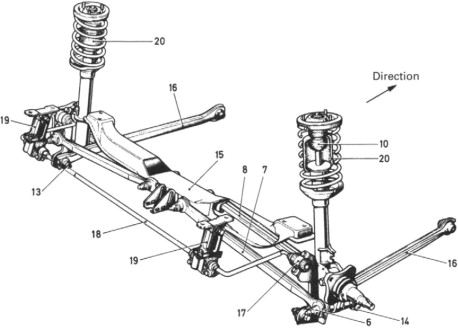
What is the difference between a shock absorber and a strut? A strut is a shock absorber that consists of one unit. It is built in with a coil spring and a strut mount.
A typical strut consists of a coil spring to support the weight of the vehicle, a housing to make the strut strong and a damper inside the housing to control the movement of the suspension. The bottom of the strut housing is connected to the steering mechanism.
Shock absorbers are actually oil pumps. At the end of a piston rod is a piston that works against the hydraulic fluid in a tube.
How do McPherson struts work?
A McPherson strut is a type of suspension in which the strut also functions as a support arm and in the case of the front wheels as a pivot. Due to its efficient design, the system is frequently used. Especially small cars benefit from it because there is often little space for a larger construction. McPherson struts work independently of each other and are found in almost all contemporary cars.
Replacing shock absorbers
Struts and shock absorbers require no maintenance. Does this mean they never need to be replaced? No, struts and shock absorbers wear out, especially when the roads are bad. This is not often the case in the Netherlands, but if a car has driven many kilometres, there comes a time when the shock absorbers have to be replaced. Sometimes, shock absorbers start to leak and become too soft.
Characteristics and symptoms replaced Shock absorber
There is leakage, the oil leaks out of the shock absorber and reduces its effectiveness.
A knocking / ticking sound can be heard on uneven surfaces.
The car continues to sway for a long time after passing a speed bump, for example.
The car tilts a lot in bends. Of course, this also depends on the character of the car. American cars are simply less rigidly sprung than cars of German manufacture.
The car becomes more sensitive to crosswinds. You can feel this in the steering wheel when there is a crosswind and you have to hold the steering wheel more firmly than usual.
During (hard) braking, the nose of the car dips.
Causes of less effective shock absorbers
As mentioned earlier, wear may occur. In the Netherlands, this wear is limited due to the good roads, but if a car has a high mileage, they may be worn out. Besides this regular wear and tear, there are a number of other causes that make it necessary to replace shock absorbers:
Driving too fast over speed bumps
Driving through a deep pothole
Hitting or driving into a curb
In the above cases, it is possible that one shock absorber is damaged, for example at the right front. In this case, it is wise to replace the left shock absorber as well. This limits the chance of deviating driving behaviour.
Do you have to replace all four shock absorbers when one is worn out?
Should I replace all four struts/shock absorbers at the same time? This is not necessary unless they are all bad. For example, if your car has four old shock absorbers that are not very expensive to replace and you want a car that runs like new again, you could replace all four. So it is not always necessary to replace all four at once. On the other hand, if the front or rear is bad, it is wise to replace two. So replace the front two or rear two at the same time.
Do the coil springs also need to be replaced?
Do coil springs or spring struts have to be replaced when replacing shock absorbers? The answer is no: if the springs or spring supports are in good condition, they can be reused with new struts/shock absorbers. However, if a vehicle is old and it is known that spring gate mountings in this vehicle are failing, it makes sense to replace the strut mountings as well.
Stabiliser rods also replaced?
Do the struts have to be replaced by stabiliser rods? No, but in some cars swaybar links are connected to the struts, see the picture above. A stabiliser bar has to be removed to replace the strut. Often the nut that holds the link grips, making it difficult to remove without damaging the link.
In this case, a stabiliser bar must also be replaced. Sway bar links are not very expensive.
Cost of replacing shock absorbers
The cost of replacing shock absorbers varies greatly depending on the brand and the hourly rate of a garage. Nowadays, aftermarket parts, including shock absorbers, are cheap. They are available from as little as €50 each on various car parts websites. An experienced mechanic should be able to replace shock absorbers in no more than 3 to 4 hours. The total price will then depend on the hourly rate. Normally, you would have to pay 300 to 400 euros for a front or rear shock absorber.
Are you going to Greece soon? For example, for a nice holiday, or because you have to be there for work? Then it is of course useful to know what the traffic in Greece is like and what you have to take into account. So are you going for transport Greeceor just recreational. Then read on
Transport Greece: The busiest roads
When it comes to road network Greece, there are some roads that are usually always busy and where there is a good chance that you will get stuck. For this reason it is advisable to avoid these roads, so that you have a better chance of not getting into trouble. An example of a very busy road is the A1 at Athens and Thessaloniki. It is better to avoid this road, otherwise there is a good chance that you will be stuck in traffic for a long period of time. Another road is the A8A from Patras to Athens. This is another location you'd better not drive along if you want to avoid the crowds.
Busy times on roads in Greece
Of course, traffic also depends on the time of year. So do you go as transporter Greece If you are travelling, it is also wise to take the different seasons into account. Especially in the summer months it is very busy in Greece. The crowds start around mid-June and continue until mid-September. In this period, there are many tourists in Greece, as Greece is a real holiday country where many people go every year. There are many beautiful sights to see and the weather is always nice and enjoyable. During this period, it is advisable to avoid busy roads. So that you don't get stuck anywhere as a transporter.
No traffic information in foreign languages
The disadvantage of Greece is that there is no traffic information in foreign languages. So as a foreigner, this does not help you very much, unless of course you speak Greek well. In those cases you can benefit from that knowledge and learn more about the actual traffic in Greece. The good thing about Greece is that you can call the tourist police if you have any questions. Tourist police: 171 (English). They can help you with various problems and provide you with different forms of information. You can also converse with them in other languages. Usually, English is the easiest, because this is a common language spoken in the Netherlands and Greece, German is also possible in many cases.
Do not drive in darkness outside cities
The Netherlands is known for its well-lit roads. We have a huge number of street lights in the Netherlands, which means that you can also drive well in remote areas at night. In Greece, it is not recommended to drive in the dark outside the cities.
Finally, drive safely and take a break now and then!
Chiptuning for your Audi, what are the benefits, costs and power gains? In this article, we not only list the benefits of chiptuning, but also compare three providers. This article is informative in nature. We have no experience with the companies mentioned. Therefore, it is wise to carefully go through the warranty terms of the chiptuner and the manufacturer to avoid any surprises later on.
What is possible with Audi chiptuning
Realistically, a performance improvement of up to 25% is possible. Experience has shown that in practice it comes down to 20%.
Theoretically, increases of more than 30 to 60% are possible. This is especially true for turbocharged engines, for example the tdi models. Whether this is wise is doubtful because the standard software in your Audi is a compromise between power and longevity. Increasing the power with 60% obviously does not contribute to the service life of the engine and the turbo in particular.
Why doesn't Audi assemble these chips itself?
As far as the software is concerned, Audi often fails to exploit the full potential of an engine.
There are two reasons for this:
The manufacturer wants a 'safety margin' for processing errors and durability. In addition, they may choose to include the same engine in the range with different power outputs. The TDI models of an Audi are a good example of this. For example, the Audi A3 2.0 TDI came with 140 and 170 hp, but these engines are identical, just with different software.
Chiptuning allows you to tap into power reserves relatively easily. Audi (especially the turbocharged engines) maintains very high safety margins, hence chiptuning in Audi need not affect the lifespan of your car.
Which Audi models are suitable for Chiptuning?
Especially the Audi A6, Audi A5, Audi A4, Audi A3 and the Audi TT series, there are many chiptuning providers. The overview below lists the different power gains for each provider. If a price is listed on the provider's website, we have also added it.
Chiptuning Audi A3
The Audi A3 has been available since 1997. Because the 8L (the first generation) is appearing less and less on the streets, we did not include it in the comparison. The successor to the 8L is the 8P, which was in production from 2004 to 2012 (a facelift took place in 2009). The 8V became the successor to the 8P in 2013. We compare VAGTechniek with Unlimited Tuning.
Power gain Audi A3 8P year of manufacture 2004 to 2012
Power gains at VAGTechniek
Audi A3 1.4 TFSI 125hp (Stage 1)
Power: 125hp > 145hp
Torque: 200Nm > 250Nm
Price: € 385,- incl. VAT
Power gains at Unlimited Tuning
Audi A3 1.4 TFSI 125hp (Normal)
Power: 125hp > 155hp
Torque: 200Nm > 270Nm
Price: € 399,- incl. VAT
Power gains at VAGTechniek
Audi A3 1.8 TFSI 160hp (Stage 1)
Power: 160hp > 200hp
Torque: 250Nm > 310Nm
Price: € 385,- incl. VAT
Power gains at Unlimited Tuning
Audi A3 1.8 TFSI 160hp (Normal)
Power: 160hp > 205hp
Torque: 250Nm > 330Nm
Price: € 399,- incl. VAT
Power gains at VAGTechniek
Audi A3 2.0 TFSI 200hp (Stage 1)
Power: 200hp > 255hp
Torque: 250Nm > 380Nm
Price: € 350, - incl. VAT
Power gains at Unlimited Tuning
Audi A3 2.0 TFSI 200hp (Normal)
Power: 200hp > 245hp
Torque: 250Nm > 370Nm
Price: € 399,- incl. VAT
Power gains at VAGTechniek
Audi A3 2.0 TFSI 265hp (Stage 1)
Power: 265hp > 300hp
Torque: 350Nm > 410Nm
Price: € 385,- incl. VAT
Power gains at Unlimited Tuning
Audi A3 2.0 TFSI 265hp (Normal)
Power: 265hp > 305hp
Torque: 350Nm > 440Nm
Price: € 399,- incl. VAT
Power gains at VAGTechniek
Audi A3 1.9 TDI 105hp (Stage 1)
Power: 105hp > 140hp
Torque: 250Nm > 310Nm
Price: € 259,- incl. VAT
Power gains at Unlimited Tuning
Audi A3 1.9 TDI 105hp (Normal)
Power: 105hp > 145hp
Torque: 250Nm > 340Nm
Price: € 399,- incl. VAT
Power gains at VAGTechniek
Audi A3 2.0 TDI 140hp (Stage 1)
Power: 140hp > 170hp
Torque: 320Nm > 390Nm
Price: € 259,- incl. VAT
Power gains at Unlimited Tuning
Audi A3 2.0 TDI 140hp (Normal)
Power: 140hp > 185hp
Torque: 250Nm > 400Nm
Price: € 399,- incl. VAT
Power gains at VAGTechniek
Audi A3 2.0 TDI 170hp (Stage 1)
Power: 170hp > 200hp
Torque: 350Nm > 410Nm
Price: € 315,- incl. VAT
Power gains at Unlimited Tuning
Audi A3 2.0 TDI 170hp (Normal)
Power: 170hp > 205hp
Torque: 350Nm > 420Nm
Price: € 399,- incl. VAT
Chiptuning Audi A4
The first Audi A4 (B5) was born in 1995 and was the successor to the popular Audi 80. The A4 had to compete with the BMW 3 and the Mercedes C-class. Initially, it was able to keep up well with this competition, but lost ground with the arrival of the e46, which was the benchmark from that moment on. The B6 was the second generation (2001-2004) and had to replace the 3 series. Although the A4 sold well, the 3 series remained market leader. Audi introduced the new B7 in 2004, although this car contained many parts of the B6. The B8 had a longer life cycle, from 2008 to 2015, and was a completely newly developed car. The last model series was launched in 2015 and had the model name B9.
Capital gains from B6
For most Audi A4 engines, nice power gains can be achieved when applying chiptuning. In the overview below, these gains are described, including price. We have chosen to start the overview from the B6, because most B5s have now driven so many kilometres that chiptuning is no longer recommended.
Power gains at VAGTechniek
Audi A4 1.8 20VT 150hp (Stage 1)
Power: 150hp > 180hp
Torque: 210Nm > 290Nm
Price: € 315,- incl. VAT
Power gains at Unlimited Tuning
Audi A4 1.8 20VT 150hp (Normal)
Power: 150hp > 195hp
Torque: 210Nm > 305Nm
Price: € 399,- incl. VAT
Power gains at VAGTechniek
Audi A4 1.8 20VT 163hp (Stage 1)
Power: 163hp > 195hp
Torque: 225Nm > 300Nm
Price: € 315,- incl. VAT
Power gains at Unlimited Tuning
Audi A4 1.8 20VT 163hp (Normal)
Power: 163hp > 204hp
Torque: 225Nm > 310Nm
Price: € 399,- incl. VAT
Power gains at VAGTechniek
Audi A4 1.8 20VT 190hp (Stage 1)
Power: 190hp > 210hp
Torque: 240Nm > 325Nm
Price: € 315,- incl. VAT
Power gains at Unlimited Tuning
Audi A4 1.8 20VT 190hp (Normal)
Power: 190hp > 220hp
Torque: 240Nm > 320Nm
Price: € 399,- incl. VAT
Power gains at VAGTechniek
Audi A4 2.0 TFSI 200hp (Stage 1)
Power: 200hp > 255hp
Torque: 280Nm > 380Nm
Price: € 350, - incl. VAT
Power gains at Unlimited Tuning
Audi A4 2.0 TFSI 200hp (Normal)
Power: 200hp > 235hp
Torque: 280Nm > 370Nm
Price: € 399,- incl. VAT
Power gains at VAGTechniek
Audi A4 2.0 TFSI 220hp (Stage 1)
Power: 220hp > 255hp
Torque: 300Nm > 380Nm
Price: € 350, - incl. VAT
Power gains at Unlimited Tuning
Audi A4 2.0 TFSI 220hp (Normal)
Power: 220hp > 260hp
Torque: 300Nm > 400Nm
Price: € 399,- incl. VAT
Power gains at VAGTechniek
Audi A4 1.8 TFSI 120hp (Stage 1)
Power: 120hp > 200hp
Torque: 230Nm > 310Nm
Price: € 385,- incl. VAT
Power gains at Unlimited Tuning
Audi A4 1.8 TFSI 120hp (Normal)
Power: 120hp > 210hp
Torque: 230Nm > 320Nm
Price: € 399,- incl. VAT
Power gains at VAGTechniek
Audi A4 1.8 TFSI 160hp (Stage 1)
Power: 160hp > 200hp
Torque: 250Nm > 310Nm
Price: € 385,- incl. VAT
Power gains at Unlimited Tuning
Audi A4 1.8 TFSI 160hp (Normal)
Power: 160hp > 210hp
Torque: 250Nm > 320Nm
Price: € 399,- incl. VAT
Power gains at VAGTechniek
Audi A4 2.0 TFSI 180hp (Stage 1)
Power: 180hp > 255hp
Torque: 320Nm > 380Nm
Price: € 385,- incl. VAT
Power gains at Unlimited Tuning
Audi A4 2.0 TFSI 180hp (Normal)
Power: 180hp > 260hp
Torque: 320Nm > 400Nm
Price: € 399,- incl. VAT
Power gains at VAGTechniek
Audi A4 2.0 TFSI 211hp (Stage 1)
Power: 211hp > 255hp
Torque: 320Nm > 380Nm
Price: € 385,- incl. VAT
Power gains at Unlimited Tuning
Audi A4 2.0 TFSI 211hp (Normal)
Power: 211hp > 260hp
Torque: 350Nm > 410Nm
Price: € 399,- incl. VAT
Power gains at VAGTechniek
Audi A4 1.9 TDI 100hp (Stage 1)
Power: 100hp > 140hp
Torque: 250Nm > 310Nm
Price: € 224,- incl. VAT
Power gains at Unlimited Tuning
Audi A4 1.9 TDI 100hp (Normal)
Power: 100hp > 135hp
Torque: Nm 135hp> 335Nm
Price: € 399,- incl. VAT
Power gains at VAGTechniek
Audi A4 1.9 TDI 130hp (Stage 1)
Power: 130hp > 170hp
Torque: 285Nm > 390Nm
Price: € 224,- incl. VAT
Power gains at Unlimited Tuning
Audi A4 1.9 TDI 130hp (Normal)
Power: 130hp > 165hp
Torque: 250Nm > 385Nm
Price: € 399,- incl. VAT
Power gains at VAGTechniek
Audi A4 2.5 TDI 155hp (Stage 1)
Power: 155hp > 180hp
Torque: 310Nm > 370Nm
Price: € 259,- incl. VAT
Power gains at Unlimited Tuning
Audi A4 2.5 TDI 155hp (Normal)
Power: 155hp > 185hp
Torque: 310Nm > 390Nm
Price: € 399,- incl. VAT
Power gains at VAGTechniek
Audi A4 2.5 TDI 163hp (Stage 1)
Power: 163hp > 180hp
Torque: 310Nm > 370Nm
Price: € 259,- incl. VAT
Power gains at Unlimited Tuning
Audi A4 2.5 TDI 163hp (Normal)
Power: 163hp > 190hp
Torque: 310Nm > 395Nm
Price: € 399,- incl. VAT
Power gains at VAGTechniek
Audi A4 2.5 TDI 180hp (Stage 1)
Power: 180hp > 190hp
Torque: 370Nm > 400Nm
Price: € 259,- incl. VAT
Power gains at Unlimited Tuning
Audi A4 2.5 TDI 180hp (Normal)
Power: 163hp > 190hp
Torque: 370Nm > 440Nm
Price: € 399,- incl. VAT
Power gains at VAGTechniek
Audi A4 1.9 TDI 115hp (Stage 1)
Power: 115hp > 145hp
Torque: 285Nm > 320Nm
Price: € 259,- incl. VAT
Power gains at Unlimited Tuning
Audi A4 1.9 TDI 115hp (Normal)
Power: 115hp > 155hp
Torque: 385Nm > 440Nm
Price: € 399,- incl. VAT
Power gains at VAGTechniek
Audi A4 2.0 TDI 140hp (Stage 1)
Power: 140hp > 170hp
Torque: 320Nm > 390Nm
Price: € 259,- incl. VAT
Power gains at Unlimited Tuning
Audi A4 2.0 TDI 140hp (Normal)
Power: 140hp > 185hp
Torque: 320Nm > 400Nm
Price: € 399,- incl. VAT
Power gains at VAGTechniek
Audi A4 2.0 TDI 170hp (Stage 1)
Power: 170hp > 200hp
Torque: 350Nm > 410Nm
Price: € 315,- incl. VAT
Power gains at Unlimited Tuning
Audi A4 2.0 TDI 170hp (Normal)
Power: 170hp > 205hp
Torque: 350Nm > 420Nm
Price: € 399,- incl. VAT
Power gains at VAGTechniek
Audi A4 2.7 TDI 180hp (Stage 1)
Power: 180hp > 215hp
Torque: 380Nm > 445Nm
Price: € 315,- incl. VAT
Power gains at Unlimited Tuning
Audi A4 2.7 TDI 180hp (Normal)
Power: 180hp > 235hp
Torque: 380Nm > 470Nm
Price: € 399,- incl. VAT
Power gains at VAGTechniek
Audi A4 3.0 TDI 204hp (Stage 1)
Power: 204hp > 270hp
Torque: 400Nm > 540Nm
Price: € 350, - incl. VAT
Power gains at Unlimited Tuning
Audi A4 3.0 TDI 204hp (Normal)
Power: 204hp > 275hp
Torque: 400Nm > 610Nm
Price: € 399,- incl. VAT
Chiptuning Audi A6
The first Audi A6 was actually an Audi 100 in disguise, which received a facelift in 1994 and was renamed the A6 (C4). The first truly all-new A6 came in 1997 and is known as the C5. This car had to compete against the immensely popular BMW 5 series (e39) and Mercedes' E-class. This A6 came with many new engines, which are also very suitable for chiptuning a.o. the TDI variants were regularly chipped. In 2004, the C5 was succeeded by the C6. This new A6 had a modern look. Partly because of this, it sold well. A number of new engines were also introduced, including the 3.0 TDI with a whopping 225 hp, and that without any chiptuning. After seven years of service, the C6 had to make way for the all-new C7, which went into production in 2011. Like its predecessor, it was again a lot bigger and got a number of new engines, including the Biturbo TDI with over 300 hp. The latest generation A6, the C8 was presented in 2018 and features smaller engines with more power. For example, the 45 TFSI already has 245 hp and a top speed of 250 km/h.
Power gains from C6
Most engines of the Audi A6 offer good power gains if you decide to use chiptuning. The overview below lists these gains, including price. We have chosen to start the overview from the C6, because the first generations of the A6 have almost disappeared from the scene.

 EN
EN  NL
NL  DE
DE