Feb 13, 2020 | Tuning |
Are you interested in having your car windows blinded without spending a lot of money? If so, then this is an article for you! On average, car window tinting costs between 200-400 euros. So if you want tinted windows but don't want to spend a lot of money on it? Then you can do it yourself, read these tips if you are going to do it yourself.
1. Make sure the windows are clean
Before applying window film to the window, make sure that they are clean and that there is no dust or sticker on them (no residue either).
If there are stickers on the inside, make sure you remove them all and do not leave any residue. If you don't, it can adversely affect the glue and you are more likely to get blisters in the film.
After you have cleaned the window, it is a good idea to empty the car as much as possible so that nothing can get in the way during application. Then thoroughly vacuum the car in order to prevent dust from sticking to the film.
2. Have an accurate meeting
Before buying film, measure the windows that need to be blinded. Buying too much film is not a problem, but buying too little can be very frustrating and even cause you to have to start all over again.
"Measuring is knowing"
Most window film is delivered in a roll, these have different sizes in both width and length. As mentioned before, it is better to have too much than too little, so you are sure to have enough. A good rule is to order two centimetres on top of your measurements.
3. First roll out the window film on the outside.
You first bring the window film on the outside of the windows.
Make sure that the film perfectly matches the size and shape of the window.
Roll out the tint of the film and place it on the window covering so that it is facing you. The lining side is the one you pull off.
4. Apply window film on the inside
Then you have to apply the window film to the inside.
After you have cut out the shape, you can remove the liner from the actual film. To do this easily, place masking tape on one side and pull the two apart by holding the tape.
After it has been applied, use a ice scraper for the film to adhere evenly to the window.
5. The law of blinding
In the Netherlands, you cannot darken the windows of your car indefinitely. Dutch law sets a maximum transparency, otherwise you will be fined and your car will be rejected during the MOT.
The Public Prosecutor's Office has drawn up the following guidelines:
"Do you want to put a film or coating on the windscreen of your car? Will it let less light through? That is prohibited in the Netherlands.
If the vehicle is allowed on the road, the windscreen must have a minimum light transmission of 75%. The light transmission of the front side windows must be at least 70%.
To be clear: 100% is full light transmission.
The rear window may have a film or coating. The vehicle must have a right exterior mirror.
All these rules are in the European Directive 92/22/EEC"
https://www.om.nl/onderwerpen/verkeer/handhaving-verkeer/autoruiten-blinderen/
Feb 12, 2020 | Tuning |
Chiptuning, or ECU tuning, is becoming an increasingly popular way to optimise the power and fuel consumption of a car. Car owners have a so-called remap done by a software specialist. This gives the car more power and reduces fuel consumption. But what exactly is chiptuning? How do you choose the right tuner and what should you pay attention to? You can read all about it on this page.
What is the ECU?
The Engine Control Unit regulates the operation of the entire engine and its components, including electronic systems (ABS, ESP, TCS) and other equipment, such as air conditioning. The ECU is therefore the 'brain' of the whole computer that determines the technical possibilities. The engine control unit is usually a microprocessor (the chip) that receives and processes data. The data comes in from various sensors, such as the air mass meter.
During production, manufacturers save universal settings of the operation in the computer memory of the car, but they are not optimised for the conditions in which the car is driven. These settings partially determine the car's performance, such as the engine speed, fuel dose, injection angle, turbo pressure (if present) and fuel injection pressure. Based on this data, the ECU selects the optimal parameters for the car's performance.
What is chiptuning?
Auto remapping, also known as chiptuning or ECU tuning, is an extremely effective and safe method for tuning engines. Engine tuning (new software) is designed to increase the engine torque and power. This can be done in two ways: by mechanical interference in the engine or by optimising the software. The first method is very expensive and often requires customisation.
Chiptuning is a simple and, most importantly, safe way to change engine operating parameters and increase efficiency. When reprogramming a car, new software is uploaded that enables more efficient engine operation.
Why does chiptuning work?
Standard software installed during the production phase does not extract the maximum potential from the engine. By using better software, it is possible to safely increase engine capacity and achieve significant power gains without damaging the engine. Moreover, changing these values can translate into better fuel economy. In some cases, this can save up to one litre per 100 kilometres. If you drive a lot, then the investment in chiptuning is quickly recouped.
For successful reprogramming, it is important that the software is adapted to the vehicle model and the capabilities of the engine and its components. Chiptuning with unsuitable software can lead to the vehicle becoming defective or even permanently damaged.
Choose an experienced chiptuner
The advantages of chiptuning are tempting and more and more people are choosing to do so. This is partly due to the low costs compared to mechanical tuning. But it is necessary to choose an experienced chiptuner who has a lot of experience in tuning your brand and model.
A company that does not know much about chiptuning may overestimate the car's capabilities and this can lead to damage and malfunctions.
Feb 11, 2020 | Electronics |
As a car owner, it is helpful if you know how to test a battery. There are many batteries today that no longer require periodic maintenance. This does not mean that they have an infinite life. Therefore, everyone still needs to know how to check the condition of a battery in their car. You can do this by using a multimeter.
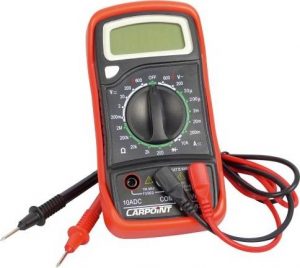
Testing the battery with a Multimeter
Some of the world's best battery testers are digital multimeters. They work best on so-called maintenance-free batteries. This type of battery has no caps that can be opened to gain access to the different chambers or 'cells' of the battery. They are sealed units, which prevent electrolytes from leaking onto the surface of the battery.
Multimeters measure voltage, resistance and electric current in an electrical device. Because batteries have an electrical charge, a digital multimeter can measure the current charge status of the battery. This will give you an idea of whether your car's battery is charged enough to work properly. If you have a maintenance-free battery, then a multimeter is suitable for your situation.
How does a multimeter work?
A multimeter works simply. However, before you start testing the battery, it is best to become familiar with the functions of the digital multimeter. There are small differences per manufacturer, but they all contain a mechanism to measure voltage and maximum voltage. Always read the manual first, so you know how to operate it.
The multimeter is supplied with two electrical connectors with metal probes. The wires come in two colours: black and red. The black coloured wire is negative, while the red coloured wire is positive. It is very important not to put them on the wrong pole. You don't want to connect metal probes to the wrong battery terminal.
If you are going to test the battery with a digital multimeter, set the device to DC or Direct Current. Make sure you set it to 20 volts. A healthy battery should have a charge of about 12.6 volts. It is sufficient to set the multimeter to 20 DC volts.
Take the black metal probe and touch the tip to the negative terminal. Take the red metal probe and touch the tip to the positive battery terminal. The resting voltage of a healthy battery is about 12.6 volts. If someone can assist you, ask them to turn on the car's headlights, then you will see a drop in the voltage reading in the multimeter. It may be 12.5 volts, for example.
Low voltage in the battery
 If the resting voltage of the battery is 12.3 volts, you can say that it contains about 75 per cent electrical charge.
It is also important to remember that there is such a thing as 'parasitic loss'. There will always be some car components that use electricity, even when the engine is already switched off. The computer, digital clock, security system and other components can still use power from the battery. This can lead to a reduction in battery charge over time.
If you test the car battery with a digital multimeter and the voltage is too low, you can take the battery out of the car and charge it overnight with a battery charger. Then test it again the next morning. If it can hold the ideal charge, it is possible that a component in the car is causing the battery to run down. If the voltage remains too low, it is probably time for a new battery.
Problem with the battery terminals
There are situations where the battery itself is not the problem. Rather, it is the battery terminals. If these are corroded, loose or dirty, you will still have problems starting the engine. It is also one of the most common reasons why people think their battery is dead.
The good news is that you can use your multimeter to check for faulty battery terminals. To do this, you need to switch off your car's ignition system. The easiest way to switch off the ignition system is to remove the relay or fuse for the fuel pump. Another method is to disconnect the ignition coil. Each of these methods prevents the car engine from starting. Only do this if you are technically skilled, otherwise a mechanic is a better option.
Now take the red metal probe from the multimeter and place the tip on the positive battery terminal. Now take the black metal probe and place it on the same battery terminal. Ask someone to switch on the engine of the car. Look at the needle on the display of the multimeter. If you read more than 0.5 volts, there is a chance that the positive battery terminal is dirty or corroded.
Perform the same procedure on the negative pole connection. You must first touch it with the black metal probe before using the red metal probe. Let your assistant start the engine. If you see a voltage reading higher than 0.5 volts, there is a problem with your battery terminals. Again, the best solution is a new battery.
FAQ multimeters
Below we have listed the most frequently asked questions about Multimeters. Do you have an additional question? Then ask it in the comment field. We will then add your question and answer to this page.
- What is a multimeter? A multimeter is a tool designed to diagnose problems with electrical and electronic circuits. It is used for checking voltages to verify proper operating levels.
- What does a multimeter measure? Standard multimeters measure current, resistance and voltage. More expensive models can also measure capacity and induction.
- Multimeters combine three functions. An ammeter measures current, an ohmmeter lets you determine resistance and a voltmeter measures the voltage between two points. Multimeters combine all three functions in one instrument.
- Measuring amps with a multimeter. The ampere measurement function of a multimeter is used to measure the number of electrons that pass a certain point for a given time. The units in this measurement are known as amps. Your multimeter can check how many amps, e.g. A device uses.
- Measuring ohms with a multimeter. The ohmmeter function measures electrical resistance - the opposition to an electric current - and uses units known as ohms. An electrical circuit has a resistance of zero or close to zero ohms when shorted. When a circuit is open, it has an infinite resistance and no current.
- Measuring volts with a multimeter The voltmeter function of a multimeter measures the electrical potential between two volt points and is particularly useful for checking whether a battery is low. In addition, a multimeter can measure current and voltage in two different modes: alternating current (AC) and direct current (DC). Domestic sockets almost always use alternating current. Please note that different countries have different standards.
Feb 10, 2020 | Safety |
Wiper blades may not be the most exciting part of a car, but old, worn or broken wipers can not only be very irritating, they can also be dangerous in a black downpour. For this reason, many manufacturers recommend that they be replaced at least once a year.
But as with all technologies, times change and wiper technology has also moved with the times. Therefore, make sure you buy the right type of wipers for your car. Below are briefly explained. In addition, you can visit our Wiper sizes page check to see what size your car is.
Traditional wipers
The traditionally most used design consists of a metal or plastic frame with four to eight points. These points apply pressure to the rubber sheet. When they are new, this pressure is evenly distributed, but as they age, this can become less. This will reduce your visibility during a rainstorm. In general, these wipers are easy to install.
Flat blade wipers
This design has become almost universal over the past decades. Despite being more expensive than traditional designs, they are easier to install with their hook-type wiper arm.
A tensioned metal strip replaces the several individual pressure points of the traditional wiper to distribute an even force over the entire rubber blade. Their moulded rubber profile also fits the curves of the windscreen more precisely. In addition, they are more aerodynamic than traditional wipers. This results in less wind noise.
Nowadays, most wiper arms are made suitable for flat blades. A disadvantage of these wipers is the fact that they wear down faster. You can notice this when they don't press so well on the windscreen and the water is not removed properly from the windscreen.
Hybrid wiper blade
Hybrid wipers are similar to traditional wipers in terms of their basic construction. They lack the tensioned metal strips. However, their plastic covers offer the appearance and aerodynamic advantages of flat blades and, due to their construction, last longer than this type. They are compatible with traditional 'hook' type wiper arm fittings and are more common on vehicles of Asian origin.
Windshield wiper size search
As mentioned before, we have documented the wiper sizes for many makes and models:
Feb 7, 2020 | Timing belt |
The timing belt of your car is (often) at the front of the engine. It is made of strong rubber with nylon-reinforced cords, which maintains the life span of the timing belt. Usually the life span is 5 years or maximum kilometres.
When a timing belt is in motion, it is under a lot of stress, which wears it out. Car manufacturers that use a timing belt such as VW, Audi, SEAT etc, prescribe an interval according to age and maximum mileage. If you wait to replace a timing belt, this can cause a lot of damage to your engine. You will end up spending much more money on repairing your engine than the initial cost of replacing the timing belt.
How do you know apart from the interval that the timing belt needs to be replaced?
If you think there are problems with your timing belt, or that it has gone bad or is starting to wear out, here are some clear signs you should look out for.
Broken valves
One of the worst symptoms a car owner can experience is that the timing belt has been cut or has completely broken. In this case, the crankshaft will rotate on its own and not be in synch with the camshaft. If this happens, the piston will hit the valves when opening, which can lead to bent valves or a damaged piston.
You can hear this clearly when you open the bonnet and your car is not moving. In this case, it is very unwise to turn on the car, the damage will increase.
Pinging engine
Timing belts have teeth, which are designed to grip gears as they turn different engine parts and components. When these teeth weaken, the timing belt slides over the sprockets (compare it to a worn sprocket on a bicycle, when you turn on the chain it slides over the sprocket). When this happens, it will cause a jolt in the engine. This also causes the engine to ping when idling.
The motor skips
Combustion in the engine can be endangered by a worn timing belt. The timing belt begins to slip away from the gears and falls on the camshaft, one of the cylinders opens and closes too quickly. If this happens, an engine failure will occur and you should have the timing belt replaced immediately.
How much does it cost to replace a timing belt?
Replacing a timing belt is something that all car owners dread, the average cost of a timing belt change is between 300 and 700 euros. As always, the price depends on the age, make and model of your car. There is also often a difference in whether or not the water pump is also replaced. It is advisable to replace the water pump, because the parts are not the biggest cost item, but the labour costs. And when the timing belt is replaced, you can easily reach the water pump, which saves on labour hours.

 EN
EN  NL
NL  DE
DE