The range of an electric car remains a tricky issue. Many people still think that an electric car cannot go further than 100 km and that recharging takes a long time. But is this still a valid thought?
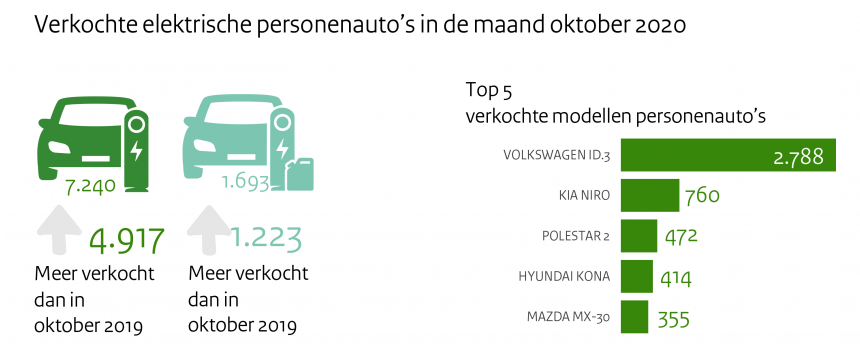
The answer is simple; no, the range of electric cars has greatly improved and this is not only true for Tesla's and Porsches. Cheaper models from Volkswagen, Skoda, Hyundai, Renault and Nissan also show increasingly better range radii. With this development, consumers are also increasingly triggered to switch to an all-electric car instead of a fuel-powered one. Meanwhile, more than 135,000 electric cars will be on the road by 2020. This is an increase of over 4% compared to 2019. This increase will increase as more affordable electric cars are added, making them affordable for people with a budget of up to €30,000.00. Renault and Skoda are even bringing models of around EUR 20,000.00 this year. These are the Twingo and the Citigo. As can be clearly seen in the image below, many Volkswagens ID 3s were sold in October. And the increase is significant, especially of fully electric cars. Sales of plug-in hybrids rose less sharply.
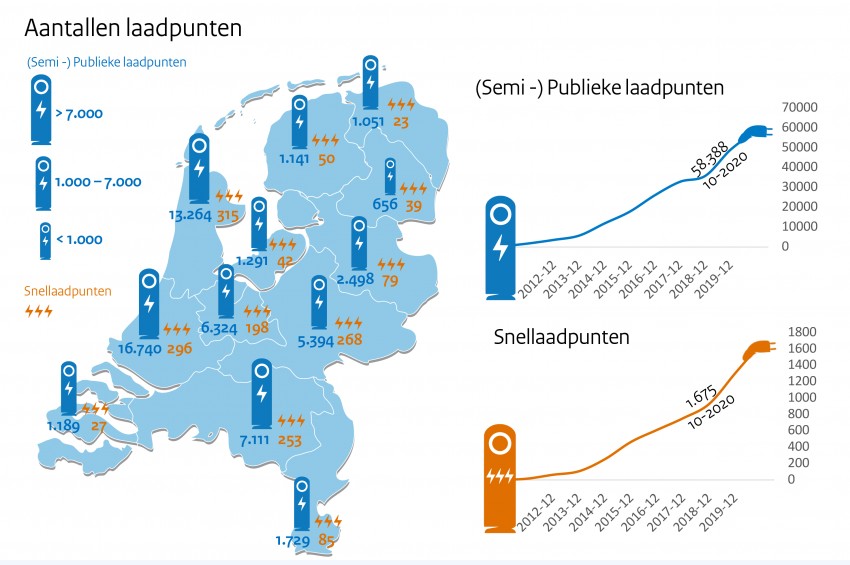
Although the average Dutchman does not completely empty his battery in one day, it is good to know that there are now more than 1500 fast charging stations. If the car is suitable for this so-called fast charging technique, it will be three quarters charged within half an hour.
The overview above was published in 2020. As more electric cars are sold, the number of charging stations will increase.
Charges for fast charging of electric car
Of course, the cost of driving a car plays an important role when choosing a car. It is easy to calculate the fuel costs of a diesel or petrol car, but it is more complicated when it comes to an electric car. The cost of recharging an electric car depends on the place, at home at the office or at the fast charger, and on the type of car.
In the case of electric cars, one pays not only for the electricity, but also for the constructed infrastructure. If we assume the cost per 100 km for convenience, in the case of a fast charger you end up with about 12. This is in most cases more expensive than costs for an average petrol car, and let's not even mention diesel cars at all. Fortunately, charging at home is a lot cheaper. Typically, you can drive 100 kilometres at home for half, €6.-. Then, of course, it becomes a lot more interesting and besides, you don't pay road tax.
Range of electric cars by make and model
There are now more than 60 models available. This number will increase significantly in the coming years. The sales figures will increase particularly as more affordable models are added. Below, we have listed the current range. The range of course depends on your style of driving, the temperature and the landscape. Therefore we have mentioned the average distances: Click on the link to go to the relevant model.
Range and features Audi E-tron
The Audi E-Tron is the German brand's first all-electric car. Fortunately for Audi, they were able to copy a lot from sister group VW. The model line does not deviate from other Audi's and I personally find the rear end very successful. This SUV falls in the higher segment and, as befits Audi, is not cheap. For over 84,000, you can become its owner. Although the top speed of 200 km/h is fine, the sprint from 0 to 100 km/h in 5.7 seconds can be called impressive. Of course, the range depends on your driving style and weather conditions, but 350 kilometres is easily achievable with a fully charged battery. This E-tron has a large battery pack, which means that recharging at home does take some time. Usually more than 12 hours.
Range and features BMW i3
BMW got there early in 2013 with their BMW i3. In its early days, this all-electric car was fitted with a small 60 Ah battery, with which it could only cover just over 150 km. BMW has since increased these batteries to a maximum of 120 Ah. The range also increased to (depending on weather and driving style) 300 kilometres. This BMW i3 is a cross between a compact MPV and hatchback. The performance is reasonable, at 160 km/h it does stop and the acceleration from 0-100 km/h is reasonable with an average of 7.5 seconds. Of course BMW doesn't sell this car for under 40,000 euros.
Range and features BMW iX3
BMW also now builds its compact SUV X3 with electric drive - not at its parent plant in Munich or the X3 plant in the US, but in Shenyang, China.
BMW initially only wanted to market the electric version of its compact SUV X3 in China. But because the larger iX5 won't be coming to Europe until late 2021, and to shorten the wait, BMW is now bringing the iX3 to Europe in January 2021.
Few external differences with the fossil-fuelled X3s
The iX3 is based on the normal BMW X3 with diesel, petrol or hybrid drive and looks very similar from the outside too. Only details such as a largely closed radiator grille and blue body panels hint at the electric drive. The interior and the load volume are also unaffected by the battery pack in the vehicle floor.
As with the combustion engines, the boot of the ix3 measures between 510 and 1,560 litres. As typical for BMW, the interior is characterised by high-quality materials. But besides fine aluminium and stylish leather, BMW also uses hard plastic in some places in the iX3, which clearly feels like it's "made in China" with a wink.
The power of the BMW iX3
The electric drive produces no less than 286 hp and 400 Newton metres at the rear axle. That's enough for a sprint to 100 km/h in less than seven seconds. The iX3 can't keep up with competitors like the Mercedes EQC and Audi e-tron in this discipline, especially since it doesn't have the four-wheel drive of the competition. A missed opportunity, or should its big brother, the iX5 soon put things right?
The ix3 accelerates smoothly and quickly to a speed of 180 km/h and this is its top speed.
The range of the BMW iX3 is fine
BMW promises a range of 460 kilometres for the ix3. In practice, with a combination of country roads and motorways, the iX3 shows an average consumption of over 20 kWh per 100 kilometres. In practice, the iX3 should be able to cover a good 300 kilometres with its 80 kWh battery, of which 74 kWh can be used.
Powering up the BMW iX3
The ix3 charges with up to 150 kW at a suitable fast-charging station. It takes 30 minutes to recharge an empty battery to 80 per cent. When charging at home, it takes seven and a half hours to fully charge.
Range and features Citroen C Zero
The Citroën C-Zero is a small electric car that offers a surprising amount of space for its small size. Its high and narrow body makes it susceptible to crosswinds and not extremely comfortable, but it is very practical.
The small electric Citroën C-Zero shares technology with the Peugeot iOn and the Mitsubishi i-MiEV. Handling tends to understeer despite rear-wheel drive. In bends taken too quickly, the ESP intervenes quickly and bumps are not absorbed great. The interior feels a bit plastic and the equipment can be described as sparse.
The power and price of the Citroën C Zero
This small electric car has a 49 kW engine. Of course, this is not an excessive amount and the top speed is around 130 km/h. The acceleration from 0 - 100 km/h is almost 16 seconds. From this, you can conclude that smoothly keeping up with the traffic is challenging. The price of this outspoken creation is around 22,000 euros. This is also the strongest point of this French car.
The range and charging of the Citroën C zero
The fact that this car is not meant for long motorway trips is also evident from its range, which in practice is around 100 kilometres. This limited distance is thanks to the small battery of only 16 kWh. An advantage of this small battery is of course the fact that it is quickly recharged. With a fast charger, it takes less than 20 minutes to get 80% and normal charging to 100% takes less than 4.5 hours.
Range and features Citroen e-C4
This Citroen e-C4 was launched in 2020 and it is not a standard hatchback. No, it is to speak in Citroen's own words, a Crossover. This means that the car has a "somewhat" higher entry level. This Citroen will compete in the C-segment and the design with the sloping roofline reminds a bit of the GS of old. With the pronounced bodywork, the French brand puts a car in the market for those who love headstrong lines. The chassis is not very innovative, because it is also used in the Peugeot 2008the Citroen C3 and the Opel Mokka. This chassis is fine for daily use, but it is certainly not built for the race track. The interior is quite sleek for a Citroen and equipped with all conveniences such as a 10-inch touchscreen. According to the factory specification, the range is 350 kilometres. This is very optimistic with a 50 kWh battery, also because this is a higher bodied car. Therefore, in practice this Citroen should be able to cover more than 250 kilometres. The battery then charges fully in just under 14 hours. With fast charging, the battery can be recharged in 30 minutes. The top speed is 150 km/h, the acceleration from 0 to 100 km/h is not officially specified, but this speed should be around 10 seconds. Finally, this Citroen e-C4 costs around €40,000.
Range and features DS3 Crossback
If you are looking for a smaller SUV-shaped car, the 'premium' brands have a lot to choose from. The Audi Q2, Mini Countryman, VW T-Cross... the list goes on and on. However, if you want one that is not powered by a petrol or diesel engine, but solely on electricity, the list is a lot shorter. Fortunately, DS (the premium Citroën) has the all-electric DS 3 Crossback E-Tense. The E-Tense has a 50 kWh battery. The range in practice is said to be more than 300 kilometres should be. Power is 134 hp and propels the DS3 to 0-100 km/h in 9 seconds. Top speed is not overbearing at 150 km/h, but it is sufficient in the Netherlands. The battery can be recharged from zero to 80 per cent in 30 minutes, of course we are talking about a fast charger.
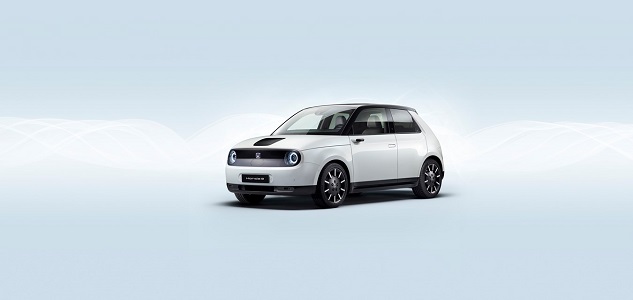
Range and features Honda e
At 3,895 lengths, 1,750 widths and 1,512 heights, the Honda e is approximately the size of a Ford Ka + or Toyota Yaris.
The Honda e's interior is sleek and futuristic. The dashboard consists of three screens connected into one and extending across the entire width. To the left and right of these are two more 6-inch monitors that show the real-time image sent by the rear-view mirrors.
Interior space Honda e
There is not much room, and the materials in the interior are conservative and ecological. The seats are covered in grey fabric and are more comfortable than they look. The parts of the dashboard that don't disappear behind the monitors look like the foils cut on wood on very old cassette recorders - and that's how they feel.
A mix of grey fabric and hard plastic is used as upholstery on the doors. "Lounge atmosphere" is how Honda's marketing department calls it with its creative exuberance. After all: in the front there is enough room for two passengers, in the back it only gets really tight when the front seats are pushed all the way back - there is not much room left for the rear passengers.
The cargo space provides only 171 litres - even a Smart has more. Those who fold down the - continuous - rear seat of the Honda e, can officially take up to 861 litres of luggage.
Power and performance Honda e
Honda offers the electric motor in two power levels: In the Advance, it boils down to 154 hp / 113 kW and 315 Nm of torque, which is readily available, as usual in electric cars. With that, the Advance makes it from standstill to 100 km/h in about eight seconds,
The regular Honda e has the same torque and 136 hp / 100 kW and it needs 9.5 seconds for the 0 to 100 km/h sprint. Both versions have a maximum speed of 145 km/h. That's not exactly great - but the Honda e is not really meant for long motorway journeys anyway, and in the Netherlands these days you can get along with traffic just fine.
The range and (fast) charging of the Honda e
The Honda e is particularly designed for city and surrounding areas. The range is tailored to this; the official range is good for 210 to 220 kilometres, in practice it will be just over 160 kilometres. The built-in lithium-ion battery has a capacity of 35.5 kWh and is recharged 80% within 30 minutes with a quick charger. Full charging takes 4 hours with the so-called "Honda Power Charger", with a conventional one it can take over 15 hours. Finally, the Honda e is available from just under 35,000 euros.
Every car has its problems, including the Alfa 147. The Alfa 147s are reliable cars if they are well maintained, but as with all vehicles there are some points you should pay attention to when buying. In this article you can read about problems that can occur with the Alfa 147. From this information you know what to look out for when buying.
The famous Twins Sparks
The engines (twin sparks) in Alfa Romeo cars use oil. If you check the oil and there is little or no oil in the crankcase, this is an indication that the car has not been maintained by an enthusiast. It is probably best to walk away at this point.
Pay attention to the timing belt interval and the camshaft adjuster
The timing belt is an important issue with the 147. At their introduction, these were given an interval of 120,000 kilometres. But Alfa Romeo reduced this to 60,000 kilometres because the timing belt regularly broke. Sometimes a rattle can come from the 4 cylinder engines which makes them sound like a diesel. This is the camshaft adjuster and should be replaced.
The Alfa Romeo with the JTD engines
The diesel engines are very reliable with no real weaknesses. Here too, the timing belt interval is quite short, at 120,000 kilometres or a maximum of 5 years. Please note that when changing the timing belt, the water pump is/will be replaced as well. These are not known for their high quality. Therefore they should be replaced with every belt change. The JTD engine is equipped with the commain rail system, which ensures good performance in terms of consumption and power.
Note the Twin-spark has 8 spark plugs
The Twin-Spark engine has a nice power output, especially in the upper part of the rev range. On the other hand, because of its character, the Twin-Spark is not very economical. 1 litre per 12-13 is feasible, but you should not have a heavy right foot. The spark plugs last about 120,000 kilometres and cost between €10-15.00 each. Remember that a twin spark has 8 spark plugs, so it can be quite expensive to replace them all.
The air mass meter and the thermostat
When the Alfa 147 has little power or runs irregularly, this can be caused by a defective air mass meter. The costs for a new air masseter are not very high. So this does not have to be an insurmountable problem. If the 147 does not get up to temperature and remains stuck at 70 degrees, the thermostat is probably broken. This repair is not very expensive either and is done regularly for these types.
Do all the panels fit properly?
When looking at an Alfa Romeo 147, check the gaps in the panels to make sure they all fit properly. Accident damage can be seen in the poor fit of the panels. You can also look under the sills for dents and a slightly different colour.
The clutch and gearbox (selespeed)
The clutches and gearboxes are very reliable, a worn clutch tends to bite on the top of its stroke and since they are self-adjusting, a high engagement point means a new clutch is needed soon. The gearboxes are generally problem-free. Selespeed, on the other hand, have more problems, mostly electronic. Check that all gears shift smoothly without grinding. For Selespeed cars, make sure that all the different gearshifts are working, i.e. the paddles, gear knob and city mode.
The suspension of the Alfa 147
The Alfa 147 suspension is sensitive. The upper wishbone can have play at both ends and can manifest itself as a squeak when driving over a speed bump. There is also a chance of worn suspension bushings and stabiliser rods. This is considered normal maintenance and contributes to the good steering characteristics of the 147.
Rust, interior and electronics
There are few problems with rust on the Alfa Romeo 147s, as the cars are all galvanised ex-factory and all interior trim is very hard wearing. The interior electrics are also generally very reliable, but it is worth checking that everything works when you test drive the car. Check these things:
Check the fan,
electric mirrors,
Electric windows,
lighter,
radio,
climate control,
windscreen wipers,
windscreen washers,
lighting,
sunroof,
tailgate release,
petrol valve unlocking device,
rear window wiper.
It is also important to check that the various electronic systems on the car are in good condition. When you start the car, three major systems are checked by the car, all of them have a warning light that comes on at start-up and goes off a few seconds later if the light does NOT come on or stays on? Then there is a fault in that system that needs to be repaired.
These systems are airbag, ABS and engine management. The airbag light is a little man with a big balloon in front of him that is located on the lower left between the tachometer and speedometer. The ABS light is a circle with ABS in the middle which is again between the two instruments and the fuel injection light is on the top right of the rev counter and looks like a yellow engine. Remember, they light up for a few seconds and then switch off. The display in the centre of the dashboard should also warn of any malfunctions. The 147 also has a CAN line connecting the various computers in the car. Any malfunctions on one of the monitored systems are indicated by a flashing light in the instrument panel.
Replacing the windscreen wiper is, in almost all cases, an easy job that does not require an immediate trip to the garage. In this article, we provide instructions on how to replace windscreen wipers, as well as maintenance tips and background information on the wipers.
Wiper operation
The wiper arm is connected to the wiper motor. The latter is responsible for the movement of the wipers. The last part is of course the wiper itself, which is mounted on the wiper arm.
The task of the wipers
The wipers should keep the driver's field of vision clear so that rain, snow and sleet, do not obstruct visibility too much. They should work quietly and not make unpleasant noises. In addition, they should not leave streaks.
Extend the life by not abusing them
The windscreen wipers should not be misused as an alternative to manually cleaning the windscreen. If you have leaves, bird droppings or stubborn insects on your windscreen. Then it is better to remove them manually. This protects the rubbers and extends the life of the wiper blades. Of course, the windscreen wipers are also not a suitable tool for removing ice and snow from the windows. If you do not have a window heater, you should use the ice scraper, not the wipers. Heavy snow loads cause the arms to bend and at some point the wiper motor may burn out.
How often should you replace the windscreen wipers?
The information on the recommended replacement intervals for windscreen wipers varies greatly by brand and model. Some brands indicate 6 months, others up to 4 years. Generally, a set can last about 2 years. However, this does not mean that they should necessarily be replaced after 2 years. If you do not see any stripes, are satisfied with the wiping result and do not hear any squeaking or other noise, you can leave them in place. In this case, 4 years is often the maximum time.
Replace hook and flat-blade wipers
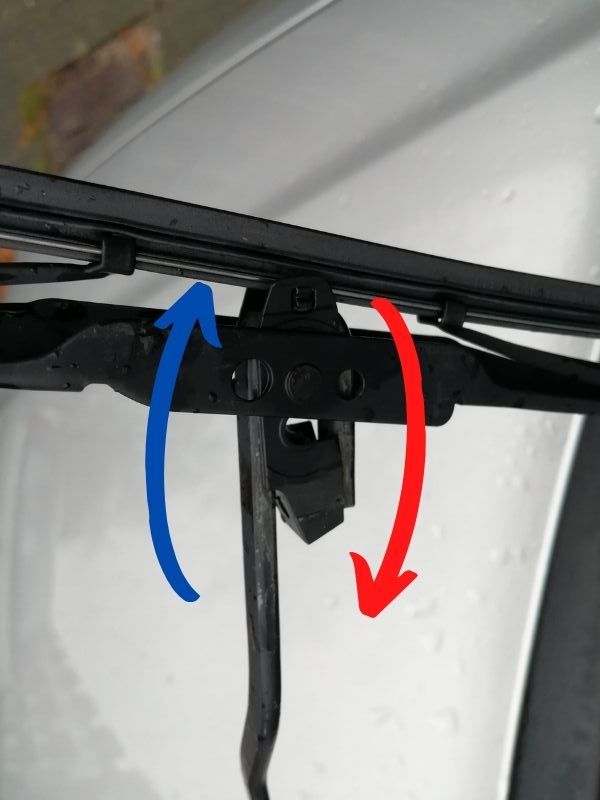
The traditional wiper system is a so-called hook arm. As the picture below clearly shows, there is a hook in the wiper arm. If there is no rust on the wipers or arms, changing them is very easy:
Raise the arms
Feel whether there is a little movement at the hook. If not, first spray a little bit of penetrating oil on it. This may need to be soaked in overnight.
If there is any movement, click the pallet in.
Then turn the wiper horizontally and slide it down from the hook
The new windscreen wiper place horizontally
Push the wiper up into the hook until it clicks.
Now you have installed the new wipers and you are ready for another 2 years.
The flatblades (Flat wipers) often have a sliding system. Bosch, for example, slides the wiper into the arm. Loosening and locking the wiper is also done with a little pallet that you have to push. Never use too much force because the arm can bend, or even break. A new wiper arm is much more expensive than a set of wipers.
A good value-for-money small car, which makes and models qualify? New cars in this class are available from around €9,000. Used, these small cars hold their value well. Which limits depreciation. This makes it difficult to choose between a new and a second-hand one.
What points you should take into account when buying a small car you will read in this article. We have also highlighted some models that are frequently sold in this segment.
Besides the size of the car, in most cases the price plays a major role - after all, buying a used or new car is one of the bigger investments in daily life.
What distinguishes a small car?
When buying a new or used car, you have the choice of many different vehicle classes - including micro and small cars, middle and upper class or SUVs. Which car falls into which category is not always so easy to determine, however, as there is no fixed definition for this. As a rule, it is assumed that the models within a vehicle class are similar in size and shape and compete on price.
When choosing a model, it is advisable to think in advance about your requirements for a car: how many people should it accommodate, do you mainly drive in town or also regularly on the motorway? And do you want to be able to put a bicycle in the boot? These are all questions you should have answers to before buying a car. Although cheap small cars are generally not pack mules, it is good to check whether the back seat can be folded down. That way, you won't be in for any unexpected surprises later at Ikea.
A small sized car is convenient in the city
Small cars are well suited to city traffic because of their size. They are particularly manoeuvrable and also fit into small parking spaces - a real advantage in big cities, where parking space is limited. The average dimensions of a small car are about 3.50 metres long and 1.50 metres wide. By comparison, high-range cars had an average size of around 5 metres in length and 2 metres in width - quite a difference.
In addition, small cars are also relatively cheap compared to the higher segment. As a rule, very cheap small cars are available from around EUR 10,000, but normally you have to reckon with costs of around EUR 11,000 for new vehicles with basic equipment.
However, it should be noted that good and cheap small cars usually offer less comfort, extras and safety and driver assistance systems than higher-end models. For years, it was also true that small cars are much more economical than larger ones. However, this is no longer generally true. The new generation VW Golf is almost as economical as its much smaller brother the VW Up.
What do Cheap Small Cars cost?
In the Netherlands, the price of cars is mainly determined by taxes such as BPM and VAT. As a result, there are virtually no cars left that cost less than 10,000 euros new. Dutch prices are 20% higher on average compared to Germany. Below, we have named the most popular models. Which we have also driven ourselves and can therefore make a value judgment about. Besides these the models below are the Kia Picanto, Nissan Micra and Hyundai i10.
The VW Up, Seat Mii and Skoda Citigo
You probably have a preference when it comes to brand. Fortunately, most brands have offerings in the smallest segment. The VW Up, Seat Mii and Skoda Citigo are virtually the same car and share almost all of its parts. These three half-sisters all started at around €9,000 when they were introduced. In the meantime, taxes and inflation have added over 15%.
The Citroën C1, Peugeot 107 and Toyota Aygo
Like the VAG models above, the Citroën C1, Peugeot 107 and the Toyota Aygo all have virtually the same parts. This was notable at the time because Toyota has no direct link to the PSA group to which Peugeot and Citroën belong.
This Japanese/French tandem was offered at its introduction for just over 8,000 euros. The Toyota was the most expensive. Meanwhile, the brands have gone their separate ways and PSA and Toyota no longer share a cheap small car. The new models are all priced above 10,000 Euros.
The driving experiences
What can you expect from these small cars when it comes to driving? Most people buying a car in this segment are price-conscious and want a (small) car that matches this philosophy. Still, it is nice if a car comes with some comfort.
The Citroën C1, Peugeot 107 and the Toyota Aygo
The first generation C1, 107 and Aygo is actually quite basic. The insulation is poor and the three-cylinder engine makes its presence clearly heard. Although the engine is present, it does perform nicely in terms of use and performance. Actually, this part, the engine is perhaps the best part of this small car. The top speed is close to 160 km/h and although the 0-100 km/h sprint doesn't look impressive at 13.5 seconds (this is due to the gearbox ratio), it is a lively little engine that is always up for the challenge. Also very reliable - check out this video from autoweek:
The handling of these types is good, it steers directly and won't surprise you easily. However, this car comes with quite narrow tyres as standard, so grip in fast corners is not infinite. But of course that's not what this little car is meant for at all. On the motorway these days, with a maximum speed of 100 km/h, this car is quite manageable. If you do decide to go 130 km/h after 7pm, it does get a bit uncomfortable in the car because of the engine noise and wind noise. The successors to these cars, for example the Peugeot 108 is a lot more mature on the motorway, the insulation is improved and this car has a lot more comfortable options on board. But whether it is more reliable than its predecessor remains to be seen in coming years.
Driving experience VW Up, Seat Mii and Skoda Citigo
You should be able to compare this VAG model, although it is more expensive than the Peugeot 107. Yet the feeling of this little VW model is very different, the interior, the finish and even the interior space seem better matched. This doesn't mean this car is better, it just depends on how you interpret better. In terms of durability, the VW Up and consorts are more sensitive to faults. This is of course because there are more options and electronics in this car. And although the performance is comparable, I do find a Peugeot 107 to be more responsive to the throttle and also a bit sharper on the steering wheel. On the other hand, this VW Up is more comfortable and quieter on the motorway.
Conclusion VW Up (Mii/Citigo) vs Peugeot 107 (C1/Aygo)
Between the above models, the VW Up and Peugeot 107, it is difficult to choose. If you want a bit more car for your money and still want to secretly holiday in the south of France, the VW is probably the better choice. This one is just a bit more balanced on long distances and also quieter, the insulation and finish are on a higher level. On the other hand, if you are looking for a car that will always do the job and if you don't attach much value to luxury, then a Peugeot 107 is probably the better choice. This French Japanese is well built and has little complicated technology, so repair costs will never be extremely high.
The cost of replacing a clutch varies greatly by make and model. There are also big differences between garagists and the corresponding hourly rate. And then there is the question of whether or not one replaces the flywheel with it. This difference is significant.
Before we get to the average prices, we will first discuss the operation and components of the clutch. By reading this article, you will gain more knowledge about this part. You will then be able to better assess whether your garage is charging the right amount for the replacement of a clutch and possibly the flywheel.
Operation of the clutch
The clutch is one of the most important parts of your car. If you have a clutch that is not working, you will not be able to put the car into gear, so driving becomes impossible.
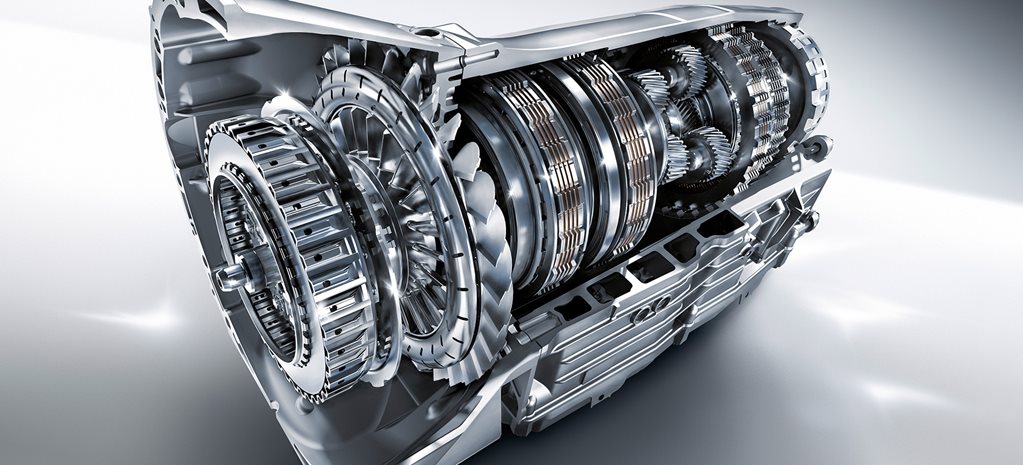
The clutch and your engine are connected via the flywheel in the engine. If there is no pressure on your clutch pedal, this causes the clutch to engage. This causes the clutch plate to come into contact with the flywheel thanks to powerful springs. There is friction between these parts, creating a solid connection that transmits the movement of the engine to the transmission.
Depressing the clutch pedal
When you press the clutch pedal, it relaxes the springs that hold the flywheel and the clutch disc together. This breaks the link because the clutch discs are no longer in contact and do not rotate.
By putting your car in neutral, an opening is created at the gearbox through which the clutch pedal can be released. In other words, you do not select any gears in the gearbox, but the clutch plate, engine and flywheel continue to rotate without the wheel moving.
Parts of the clutch
As described, the clutch consists of several parts and they are all subject to wear and tear. Most people are familiar with the flywheel and the pressure plate, but there are more parts that make the clutch work. The clutch disc is one of them and sits pressed against the flywheel. This thin round disc is connected to the gearbox input shaft. Next to that, you have the thrust bearing and the lever. These ensure that the clutch plate comes off the flywheel and that shifting can take place.
Clutch replacement costs per make and model
The costs listed below are always an indication. The actual costs vary from garage to garage. In addition, it is important to ask a garage whether original or aftermarket parts are used. Using aftermarket parts, when a car gets older can be a good way to keep maintenance affordable. With these aftermarket parts, you can quickly save 20% on your car's repair costs.
Below are the cost indications of the most popular brands and models.
Audi A3, A4 and A6 1.9 tdi engine
The famous 1.9 tdi engine is fitted in many models. From 90 to 150 hp, the VAG parts are usually of good quality. However, due to the high torque of this diesel, the clutch can sometimes give up the ghost.
Clutch replacement 1.9 tdi without flywheel (indication): 500-600,- euro
In some cases, the two-mass flywheel is replaced with a single one. This can cause a little more vibration in the car. On the other hand, they are often more wear-resistant.
Audi A3, A4, Q3, Q5, and A6 2.0 tdi engine
Although the 2.0 tdi engine had some teething problems in the early years, it is a fine engine to drive. Unfortunately even with these engines the clutch does need to be replaced from time to time. Unfortunately the costs are often much higher compared to the 1.9 tdi.
VAG's 100 hp 1.6 is also frequently used in cars originating from this group. So too in several generations of the A3 and A4. As we would expect from VAG, the clutch is of good quality. As these cars get older and they are regularly driven in the city, where there is a lot of shifting, the clutch may have to take a turn.
Clutch replacement 1.6 without flywheel (indication): 450 - 600,- Euros
Clutch replacement 1.6 with flywheel (indication): 900 - 1200,- Euros
BMW 1 series, BMW 3 series and 5 series 1.8d and 2.0d
The 2.0d has been used in many BMW models. Over the years, this smooth and economical diesel has undergone some updates. Because of this, there may be a difference in costs when replacing the clutch and flywheel. Versions with an automatic gearbox are not included.
Clutch replacement BMW 2.0d without flywheel (indication) 600 - 700,- euro
Clutch replacement BMW 2.0d with flywheel (indication) 1200 - 1500,- Euros
Ford Focus and Mondeo 1.6, 1.8, 2.0 and TDCI engines
Ford is known to have a good price/quality ratio. Fortunately, these friendly prices also apply to the maintenance costs. The parts like the clutch and flywheel are a lot cheaper compared to BMW for example.
The 1.6 and 1.8 and 2.0 engines in both petrol and diesel are widely sold in the Netherlands. Below is an indication of the cost for replacing a clutch and possibly the flywheel.
Clutch replacement 1.6 to 2.0 engine (TDCI) without flywheel (indication) 400-500,- Euros
Clutch replacement 1.6 to 2.0 engine (TDCI) with flywheel (indication) 900-1100,- euros
Peugeot 107, 206, 207, 307, 308 1.0, 1.1, 1.4, 1.6 and 2.0 and HDI engine
Peugeot is a popular brand in the Netherlands. Thousands of the above models have been sold. Therefore, replacing the clutch of these models is a common repair. The after market parts for Peugeot are relatively cheap because they are produced in large numbers. Below the cost indication overview of these engines/models:
Clutch replacement 1.1 and 1.6 engines without flywheel 400 - 500,- euros
Replace clutch 1.4 and 1.6 engines with flywheel 900 - 1200,- Euros (hardly ever needs to be replaced as this is a single/fixed flywheel)
Clutch replacement 1.6 and 2.0 HDI engines with flywheel 900 - 1250,- euros
Volvo V70, S60, V50, S40, S80, Diesel and Petrol
Past Volvo cars in particular were bullet-proof so were the parts. It was the rule rather than the exception for Volvo clutches and flywheels to last more than 3 tonnes. Now Volvo drivers often drive a lot, so 3 tonnes is not unusual by Volvo standards. The cost of replacing a clutch varies greatly by type. The V50, for example, shares a lot of technology with Ford and is therefore relatively cheap to maintain. With the "real" Volvo models, such as the S60 and first generations of the V70, the costs can be higher.
As most people know, Audi and VW share many parts and they both belong to the VAG group. A VW specialist will in almost all cases work on Audi, VW, Seat and Skoda. The prices for replacing a clutch and possibly the flywheel will therefore not differ much. The VW Polo, for example, does come with smaller engines, including the 1.2 three-cylinder. The prices for replacing a clutch excl. and incl. the flywheel are listed below.
Clutch Polo without flywheel (indication) 400 - 600 Euros
Clutch Polo with flywheel (indication) 900 - 1200 Euros
Look for the TDI variants at Audi - the costs should be similar.




 EN
EN  NL
NL  DE
DE 