1 August 2026 | Buying advice
For car enthusiasts, other countries are a treasure trove. In Germany, platforms such as mobile.de and autoscout24.de have over a million cars for sale – ranging from a well-maintained ‘youngtimer’ to a rare model that’s almost impossible to find in the Netherlands. No wonder more and more people are looking across the border for their next purchase. But how do you go about importing a car sensibly? We’ll walk you through the key steps.
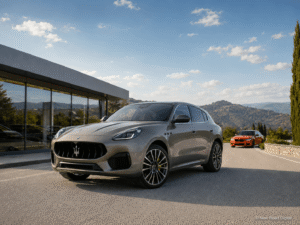
Why shopping across the border is so appealing
The biggest advantage is the wide choice. As the market in countries such as Germany and Belgium is much larger, you’re more likely to find exactly the model, colour and specification you’re looking for. What’s more, prices are often more favourable and many cars are better maintained. Thanks to depreciation and a favourable BPM calculation, importing a car can also save you thousands of euros compared to a similar model in the Netherlands.
What to look out for
Still, importing a car involves more than just choosing one and paying for it. Anyone who importing a car from abroad If you decide to buy a car, you’ll need to sort out transport, a BPM declaration, an RDW inspection and vehicle registration. The vehicle’s history is also important: have the paperwork checked in advance to ensure it’s in order and that the car doesn’t have a history you’d rather not inherit. This will help you avoid costly surprises.
The BPM at a glance
BPM stands for tax on passenger cars and motorcycles. This tax does not exist in other countries, so you must always declare it when importing a vehicle, even if the amount is zero euros. The amount depends on factors including CO₂ emissions, the list price and the age of the vehicle. For a second-hand vehicle, you pay a residual BPM based on depreciation. There are several calculation methods, and choosing the right one can make a significant difference to the amount you ultimately pay.
Do it yourself or get it sorted?
You can handle the whole process yourself, but that requires time, knowledge and a good understanding of the rules. Many people therefore choose to outsource the transport, inspection and paperwork to an import company. Such a specialist will inspect the car, calculate the lowest possible BPM and arrange for the MOT and registration, often in their own workshop. All you need to do is choose the car and provide the details.
The three-step process
Broadly speaking, the import process takes place in three stages. First, you search for and choose the car, either on your own or with help. Next, the costs are calculated and the BPM is sorted out, so that you aren’t faced with any unexpected charges. Finally, there’s the transport, the MOT and the registration. On average, this process takes between one and three weeks, depending on the country of origin and the transport arrangements. Bear in mind that importing a vehicle from outside the European Union may take a little longer due to customs clearance and formalities.
Which countries do we import the most from?
Most imported cars come from our neighbouring countries. Germany is by far the most popular choice thanks to its huge range and competitive prices, followed by Belgium. However, there are also plenty of imports from further afield, such as France, Italy and Spain. It is even possible to import cars from outside Europe, for example from Japan or the United States. If you’re importing a vehicle from outside the European Union, there are additional steps involved, such as customs clearance and customs duties, so make sure to factor these into your budget.
Why a vehicle’s history is so important
A car from abroad may look perfect in photos, but the story behind it is just as important. You should therefore check that the mileage is correct, whether there is a history of damage, and whether all the paperwork is in order. A thorough check beforehand will prevent you from buying a vehicle with a hidden fault or an unclear history. With an imported car in particular, that peace of mind is half the battle.
Look at the bigger picture
Don’t be swayed by the asking price alone. Factor in transport, BPM, MOT and registration costs to see whether the car really is better value. By doing the maths in advance, you’ll know exactly where you stand and can go ahead with confidence when you come across your dream car. This makes importing from abroad a smart and enjoyable way to get your next car.
8 December 2025 | Formula 1
Race overview and results
Lando Norris became world champion. It happened in the season finale. Max Verstappen won the race and recorded his eighth victory of the year. But Norris did exactly what was necessary. He finished sensibly in third place and maintained his lead in the championship.
How McLaren secured the title
McLaren made the difference with a split tactic at the start. Oscar Piastri started on hard tyres. Norris started on mediums and didn't have to push as hard. That choice gave McLaren a lot of strategic flexibility. Red Bull was surprised by that move. As a result, Verstappen had fewer options to respond differently.
First round and the plan
Piastri made a daring overtaking manoeuvre on lap one on the outside of turn 9. Norris did not defend aggressively. The plan became immediately clear. Piastri on the hard tyres could drive much longer. That forced Verstappen to put more strain on his medium tyres. Norris was able to save his tyres and thus reduce the risk of graining.
Why it worked
Piastri's longer stint disrupted McLaren's race. Verstappen had to set a fast pace early on to put pressure on Piastri. As a result, he was stuck with a different strategy. This made it difficult for Verstappen to push Norris back towards the midfield with varying tactics.
Problems and moments of tension
There were some hiccups in the plan, though. Charles Leclerc drove very strongly and stayed close to Norris. At full speed, Leclerc drove lap times comparable to those of Norris, who was saving his tyres.
On lap 14, George Russell attempted to undercut Leclerc. Ferrari and Norris had to react quickly. As a result, Norris had to pit earlier than planned. He ended up in traffic, which also included Yuki Tsunoda, who was clearly providing strategic support for Verstappen and driving on hard tyres.
Tsunoda attempted to block on the long straights. That move did not stop Norris. Norris did manage to get back into the top three and remained about six seconds behind Verstappen after he had already pitted.
Final stages and decisive stop
Piastri then remained in the lead for eighteen laps on hard tyres. He was about to pit, but had to wait a moment. Norris had to pit earlier to cover Leclerc after Ferrari had pitted for the second time. That pit stop meant Norris returned to the track behind Piastri.
By the end, Verstappen's tyres were already thirty laps old. The McLarens were driving more than a second per lap faster, but they were too far behind to really attack. Norris eventually cruised to the finish line and secured the title.
Results and notable performances
Leclerc drove a strong race and finished fourth. Russell later lost pace due to tyre problems and finished fifth. Fernando Alonso came in just behind him with a late overtaking manoeuvre. Esteban Ocon defended well and maintained his position against Lewis Hamilton. Hamilton had a disappointing weekend, but still sought out the champion immediately to congratulate him.
Important moments summarised
- McLaren split the starting strategy: Piastri on hard tyres, Norris on medium tyres.
- Piastri put pressure on Verstappen right from the start, forcing him to work harder.
- Russell's early undercut on Leclerc accelerated pit stops and temporarily put Norris in traffic.
- Tsunoda tried to block, but Norris still managed to pass him.
- In the end, the McLarens proved to be faster, but too far behind to still be able to win.
Conclusion
McLaren took a clever approach. The combination of Piastri's long stint and Norris's tyre management proved decisive. Norris secured the title for the team after 17 years. It was a strategic triumph of teamwork and a well-deserved result for the young driver.
WORKS!
8 December 2025 | DTM
Güven opts for WEC and Le Mans
It's official: Ayhancan Güven will not defend his DTM title in 2026. In a post on Instagram, the champion announced that he will not be driving in the DTM next year and will instead compete in the FIA World Endurance Championship. This will also mark his debut at Le Mans.
Güven, who was recently appointed factory driver by Porsche, will race for Manthey in the LMGT3 class. He will lead the driver trio in the second Porsche 911 GT3 R Evo; the team is expected to announce the names of his teammates in mid-December.
Reason for the choice and consequences for DTM
Manthey said he would have liked to continue with Güven in the DTM, but that the driver and Porsche have opted for the WEC programme. This decision is in line with Güven's plans to focus on the transition to Formula E at the end of 2026. The 2026 season will be a transitional year for him to prepare for that step.
There are several practical reasons for this. Güven still has little formula experience, although he did drive an impressive rookie test for Formula E in Berlin. In addition, he needs FIA licence points for a Formula E licence. There are more points to be earned in the LMGT3 class of the WEC than in the DTM, which makes the choice logical. He can also gain experience in long-distance racing in the WEC, and he will probably remain involved in classics such as the 24-Stunden-Rennen at the Nürburgring.
Rumour has it that the Porsche organisation helped drive this shift, partly to prepare Güven optimally for the electric class. Manthey confirmed that they are delighted with his arrival at the WEC and that they want to take the next step together.
For the DTM, Güvens' departure means that Manthey is looking for a replacement. Ricardo Feller is expected to take his place.
Looking back on Güven's DTM career
Güven looks back on his time in the DTM with mixed feelings. He made his debut in 2022 at the Norisring, where he replaced Nick Cassidy at AF Corse through the Red Bull connection and immediately impressed with a third place on the grid. That opportunity led to a permanent spot and ultimately to three strong years culminating in the championship.
He describes his departure as not an easy decision, but also reflects on what he has achieved: from substitute driver to DTM champion and now a step closer to an international endurance racing career and Formula E.
- Güven will not defend his DTM title in 2026
- He will be competing in the FIA WEC, LMGT3 class, in 2026.
- Le Mans debut is on the agenda
- Manthey to announce teammates in mid-December
- Considerations: Formula E preparation, FIA licence points, more WEC points
- Likely successor at Manthey in DTM: Ricardo Feller
6 December 2025 | Formula 1
Situation for the title race
The championship comes down to Abu Dhabi. Lando Norris has the best chance. He is 12 points ahead of Max Verstappen. According to reports, Oscar Piastri is four points further back.
Both McLaren drivers appeared together at a mandatory FIA press conference. That was their only media activity this Thursday in Abu Dhabi. However, that choice is fuelling all kinds of speculation.
Parliamentary uproar in Australia
In Australia, the story took a strange turn. A parliamentary committee cited Piastri and McLaren's alleged bias. This arose partly from the team's choice in Qatar. McLaren did not immediately bring its cars in under an early safety car. According to critics, this cost Piastri the victory.
The incident in Qatar limited Piastri's advance on Norris. It also made room for Verstappen to overtake Piastri in the standings. As a result, Piastri is now considered the biggest underdog of the three.
Piastri responded with surprise and delight that his name had even been mentioned in parliament. He described the support from Australia as extraordinary and said he would do his best to celebrate it at home.
Media claims versus facts
An Australian report stated that Piastri had been banned from his national media and that Norris had separate sessions. That is not correct.
McLaren decided not to schedule any additional voluntary media appointments in Abu Dhabi. This applied to all media outlets. Norris also did not hold a separate briefing with British newspapers. The decision was made by the team. Neither Norris nor Piastri requested any additional media appointments.
Why the rumour persists
The underlying unrest is not new. Fans and journalists have been pointing out cases for months where it seems that Norris was given preferential treatment. There were some notable race decisions that led to discussion. Piastri's poor performance in the US and Mexico also fuelled the doubt.
- In some races, Norris was given strategic choices that sharpened him in comparison to Piastri.
- In Italy, Piastri was asked to let Norris pass again after an unintentional undercut.
- Piastri experienced a dip in form in the US and Mexico, which may have been due to technical reasons.
- Piastri's strong comeback in Qatar made the situation even more sensitive.
What McLaren says
The team consistently emphasises that it does not favour any particular driver. McLaren provides technical explanations for the results. For example, some circuits require grip and a driving style that suits one driver more than another.
Nevertheless, the narrative persists. Minor errors or unfortunate team orders reinforce the perception of inequality. It is challenging to completely refute this.
About missing FP1
Some saw Piastri's absence in FP1 as evidence of a conspiracy. In reality, it has to do with mandatory rookie sessions. Abu Dhabi is one of the least relevant FP1s. It is a daytime race on a dirty circuit, so many teams use that session for young drivers.
Conclusion
The case revolves around reputation and perception as much as it does around facts. McLaren attempted to avoid additional distractions by not planning any voluntary media appearances. Nevertheless, old incidents and ambiguities continue to fuel the discussion.
Whether there really is favouritism has not been proven. The rumours will only die down if the team is consistently open and the results speak for themselves. For now, Abu Dhabi remains the arbiter of sporting judgement.
6 December 2025 | DTM
Test at Le Castellet
The first test with the Pirelli tyres specially developed for DTM did not go as planned. During the two-day test on 26 and 27 November in Le Castellet, seven manufacturers tried out two prototype tyres. This quickly caused considerable unrest among the teams.
The core of the problem was severe wear and tear and so-called graining. Mercedes-AMG drivers had to abort their long runs after about eight laps because the tyres became unusable. Other brands, including the Emil Frey Ferrari team, saw the same trend.
Some cars saw their lap times drop significantly in short bursts: one Ferrari lost up to eight seconds in nine laps on one run, while another run showed a loss of four seconds in ten laps. On some tyres, the surface cracked due to overheating.

 EN
EN  NL
NL  DE
DE